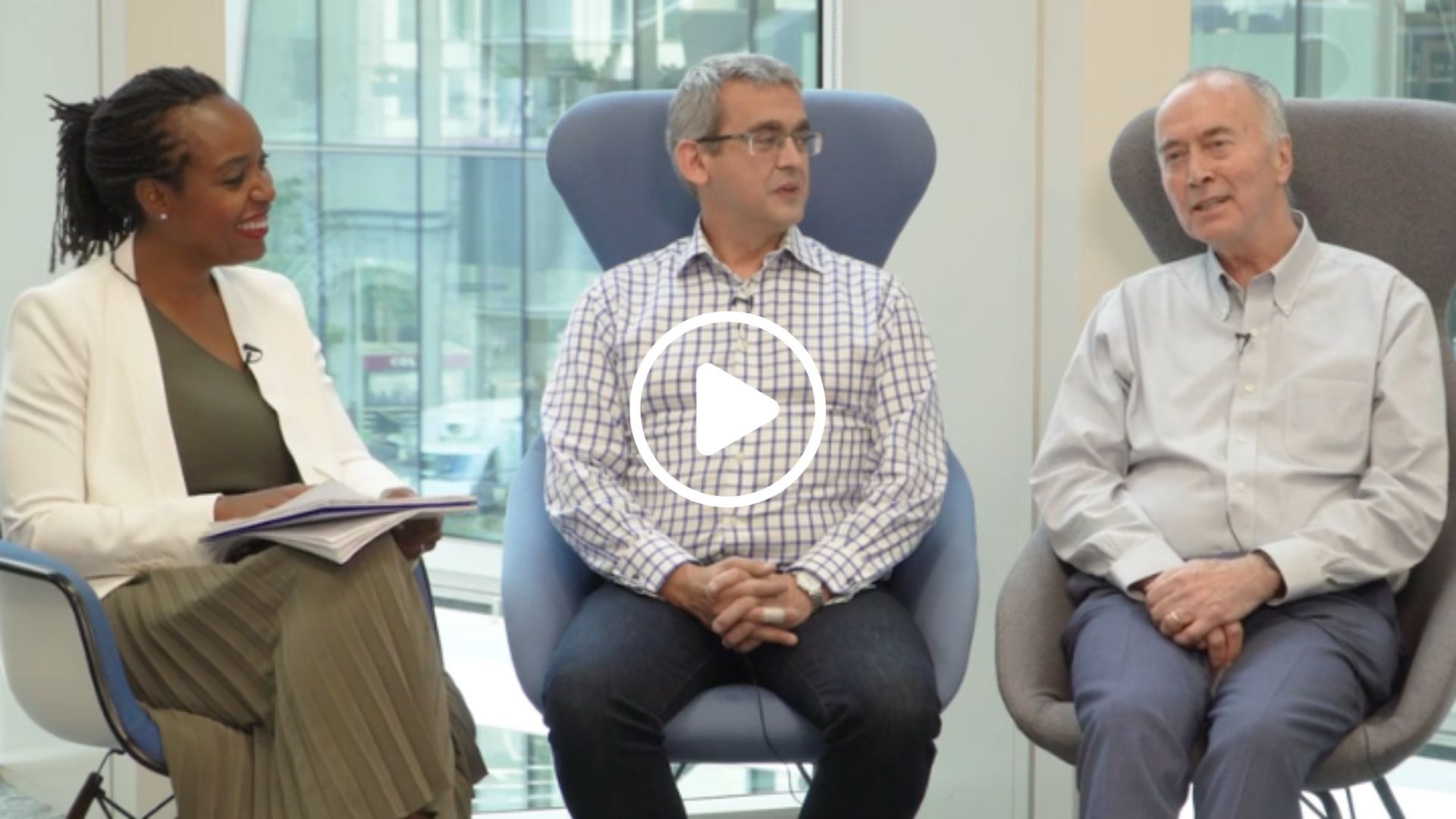
This year the Thinking Ahead Institute turned 10. To mark the occasion, we interrogated our two co-founders with an off-the-record interview. The Thinking Ahead Group was first established back in 2002 and then the Institute was launched in 2015. Our founders reflect on the journey and why bold ideas still matter.
Let’s take a step back, what led you to the creation of Thinking Ahead?
R: It was a perfect moment to ‘marry’ Tim’s critical thinking talents with an industry gap with, well, thinking ahead. There were too many pressures to think and act on short-term agendas, the initiative was set up to help our asset owner clients to be thought leaders – investors that could follow on the best ideas and lead on the best portfolios.
T: The origin would have been in marrying bleeding edge investment ‘technology’, like portable alpha and smart beta, with the emerging promise of behavioural finance. Since then we have worked on many topics – including (but not limited to!) risk budgeting, governance, extreme risk, culture, sustainability, TPA, and systemic risk.
Did Thinking Ahead evolve in ways you never initially expected?
…Thinking Ahead is increasingly seen as the go-to to tackle the trickiest, stickiest, scariest, hairiest challenges.
R: Yes, big thinking ideas are always hostages to the world changing in ways we could never expect. This is at the heart of one of the five axioms we would go to the stake for – the need to reconcile the ‘same as ever’ with ‘different this time’1. But it has evolved exactly the way it was meant to in terms of producing strategic capital – the scarce ideas that break through over time. What hasn’t been easy has been monetising such an intangible item. But I’m increasingly confident that intangible capital applied to tangible projects is the way forward, and Thinking Ahead is increasingly seen as the go-to to tackle the trickiest, stickiest, scariest, hairiest challenges2 .
T: Not really – because I was very careful to manage my expectations at the start. I had no idea if TAI would succeed, or for how long, let alone how it might evolve. Actually I can give you one thing – I didn’t expect time budgets to be slashed, nor attention spans to be cut so aggressively. This is forcing an evolution in how we communicate – but the thinking still takes just as long.
Thinking Ahead members get to collaborate with one another. What impact have you seen from this collaboration over the past decade?
T: In my darker moments I worry that there has been no impact from all this work. And then a member will make a comment, or you will hear about something that lifts your mood. However, let’s be honest, attribution is very difficult here – so let me state that I subscribe to the (I think) Ronald Reagan quote: “it’s amazing how far you can get, if you don’t mind who gets the credit”. I would like this to be an over-claiming-free zone. All that said:
- I have had members tell me that TAI has changed how they see the world, and how they think
- And members tell me that they have overheard colleagues discuss TAI ideas in the normal run of business, showing that the ideas can seep into organisations
- I have witnessed constructive debates between members, and I have seen questions asked and useful answers given between members
- I have been privileged to attend whole-day TAI events (remember them?) where we ended with a better collective understanding, and closer social ties
- I have loved being part of TAI working groups where we co-create together
- I have observed workshops and projects that directly addressed individual member needs
- And I believe there are some investment products and portfolios with “TAI inside”
Does that amount to ‘impact’? I am happy to leave it to others to judge.
R: My best recent example is the 2024 Peer Study which we conducted across 26 funds selected for their strong governance, significant size, and thoughtful international perspectives.
Self-awareness and understanding of peers and competitors have been central to the successful evolution of all of these organizations – the Study was an avaricious consumer of this wisdom
All funds agreed. The future will be increasingly different from the past, requiring organizations to be more responsive, responsible, adaptive and agile.
The study applied a systems perspective to understand this world of asset owners and to advance nine propositions of where to apply their focus in the next five years
The top three: total portfolio approach (TPA), an alts-plus plan and 3D investing. All of these support the organizational alpha of these funds in which their governance, culture, talent, and technology add together in a potent mix to drive future returns.
If TAI lived up to its full potential, how would the world be different?
T: Ugggh – horrible question. The world would be a happy shiny place? We are a team of 10 people, so about 0.00000002% of the global workforce – so what should our “full potential” look like? We would need to invoke some seriously effective influencing, and for the network effects to quickly reach people in high places. Our job is to think ahead and build better maps of the future. If we are successful then those better maps allow our members to make better decisions in the present. Unfortunately, those maps now necessarily include climate change, biodiversity loss and inequality – the piling up of past externalities from economic processes. We weren’t around when those externalities piles were started – and even if we had been, would anyone have listened to us? So rather than wish for a different world, I think us living up to our potential is being the best possible guides through a difficult and uncertain future.
Our job is to think ahead and build better maps of the future. If we are successful then those better maps allow our members to make better decisions in the present.
R: TAI is privileged to work in a mega-impact area – influencing the biggest pools of capital to aim to work smarter and better. ‘Smarter’ – our work suggests a lot of money is ‘left on the table’ by organisations in their practices, and usually in unknowing but fixable forms. ‘Better’ – our work opens a pathway for these pools to produce positive real-world impacts.
We have promoted ‘the 4321 pin code concept’ to explain how this can happen. The thinking here starts by allocating a budget of 10 units of influence to different players within the economic and political framework:
4 units to governments and policymakers; 3 units to companies; 2 units to financial institutions, TAI’s members, 1 unit to individuals (citizens, consumers, workers, voters, activists, etc.). The roundness of it is deliberate, it’s the order-of magnitude we are driving at.
This framework helps to think about the role of finance in delivering change and how to work with others to achieve it. No one entity can move the world, but big players can make their mark when combined with other efforts. In a test of this principle 70% of the big funds in our Asset Owner last year agreed with this principle and were acting on it.
More than 10 units are required to solve challenges like climate change. Therefore, combining units to create a multiplier effect is essential. The asset owners to become “titans of influence,” must use leadership, collaboration, purpose, and vision to lead to movement and ultimately change.
TAI originated the concept of 3D investing, which balances risk, return and real-world impact, where investments not only generate financial returns but also contribute positively to longer-term societal and environmental outcomes. By integrating these three dimensions, investors drive sustainable growth and apply that multiplier effect leveraging their democratic role. After all asset owners are investing the wealth of the majority of the global population. So the influence we wield on the 2 units of finance, use the power of the 1, to influence the 4 and drive positive real-world outcomes from the contributions of the 3. Yes, a tad convoluted, but heh our world is increasingly complex, but this is a massive (simple) opportunity that TAI has matured in the last decade and is now seeing the fruits.
What are you most proud of building through TAI?
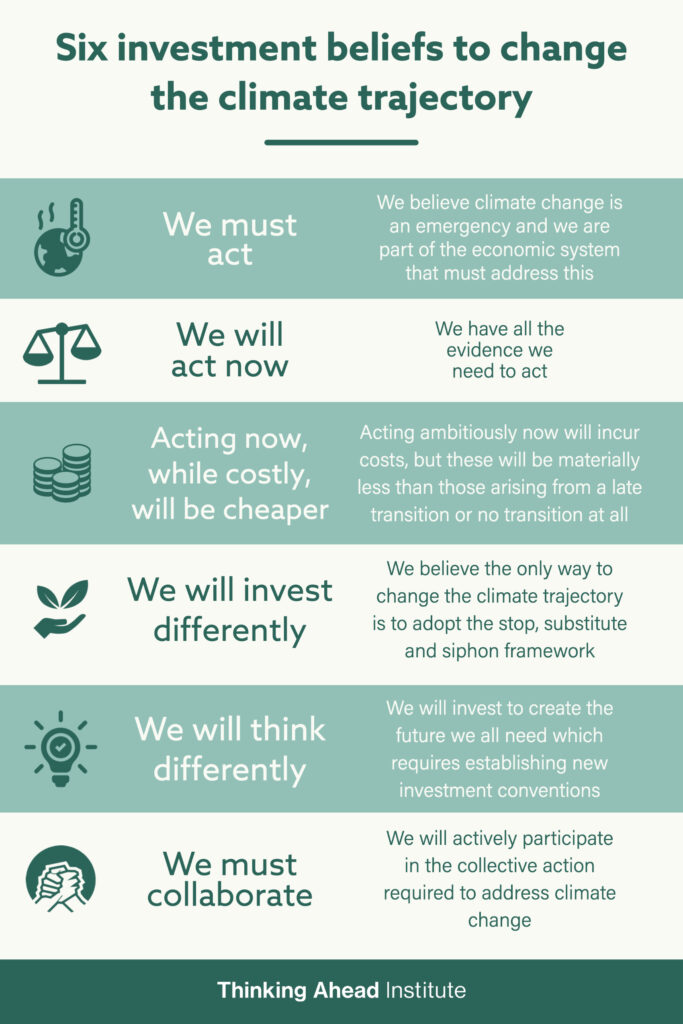
T: An amazing team and a pretty special member community. One particular highlight was a sub working group that formed to create a set of climate beliefs. We set ourselves up to operate as a ‘superteam’ and over 16 weeks delivered some extraordinary work. My perfect member co-creation example.
R: Tim describes it well. I think we developed a world class team that had world-class connections.
1 In last year’s post Navigating 2024: expecting the unexpected and the expected, we came up with some general principles; and the big examples of our day: Systems: thinking beyond parts to wholes; Tipping points: climate and social dynamics; Post-truth realities: navigating the misinformation era
2 The other four axioms. See this year’s post.
Explore our website
View the latest: Global DC Peer Study 2025
Visit our Total Portfolio Approach Hub
Join one of our newsletters for the latest insights into your inbox
Listen to our latest Investing for Tomorrow podcast with industry leaders
Sign up to one of our upcoming events
Find out more about what we do here at the Thinking Ahead Institute
Selected insights for you
We’ve a few insights you might be interested in:
- We need superteams to change the climate
- Consider a beautiful island…
- Stronger together
- Climate tipping points change everything
Related content
Take a look at our content on Investment beliefs to change the climate trajectory