Welcome to the Thinking Ahead Institute’s 2026 research activities
We are committed to exploring the forces shaping our industry through collaborative research, shared learning and engagement. Our research activities are designed to inspire innovation, sharpen strategic thinking and drive meaningful progress across critical areas of focus.
In the year ahead, we will continue to advance work in key domains including defined contribution (DC) systems, total portfolio approach (TPA), and wealth management. We will also deepen our exploration of long-term thematic trends and improving governance and organisational alpha.
Through targeted projects, one-to-one engagements, and global industry studies, we build on our strong tradition of research excellence—ensuring our insights are both forward-looking and directly relevant to your organisation’s needs.
We encourage our global network to actively participate in our research efforts, contribute perspectives, and connect with one another for shared learning.
Together, we can shape the future of investment and deliver enduring value to all stakeholders.
Browse by clicking though the topics on the left panel.
- Defined contribution
- Wealth
- Total Portfolio Approach
- Long term thematic trends & insights
- Industry surveys & peer groups
- Projects and 121s
- Our working groups
Global DC research
In 2025, we brought together insights from 20 leading DC organisations for our Global DC Peer Study. A consistent message emerged: the need to build a stronger, end-to-end experience for members throughout their lifetime. This now shapes our 2026 DC research agenda as we work to enable DC become a more complete pension system.
We are focusing on two key areas:
- Decumulation solutions that meets member needs with institutional strength: How can DC organisations bring institutional capabilities, such as investment design, risk pooling, governance and decision support, into retirement solutions in ways that members understand and trust?
- Enabling DC organisations to better manage risk through time: How can DC organisations better manage risk across the full lifetime journey, from accumulation to decumulation, to improve member outcomes?
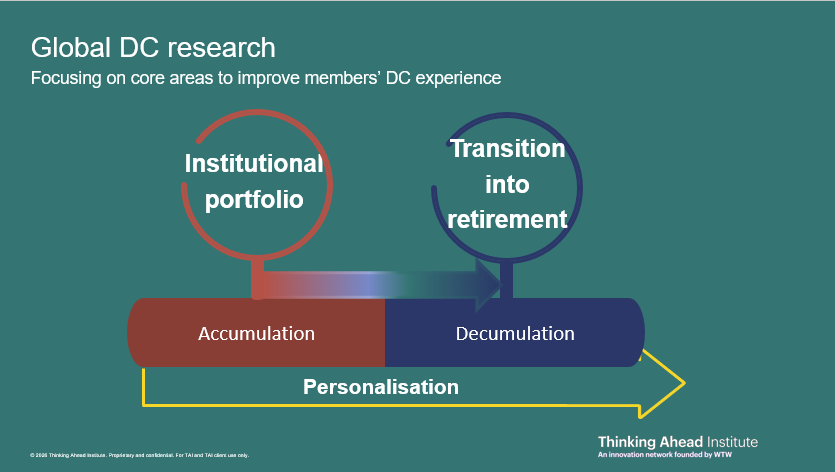
Personalisation underpins both themes: designing DC pensions around individual circumstances, deliver these solutions at scale and reasonable cost.
Together, it can help create a pensions system that incorporates the four core elements of security, affordability, sustainability (intergenerational financial fairness) and systemic resilience through time that helps deliver better member outcomes.

Our work on DC research is only as strong as the organisations behind it. Join us by sharing your research, participating in our SHAPERS series to share case studies with peers, or contributing to thought pieces that explore investment design, risk, and creating pensions that truly meet member needs.
Jessica Gao
Researcher, Thinking Ahead Institute
Find out more about our SHAPERS event on DC
Please contact Jessica Gao to know more.
Related pages
Global wealth research
Building on our 2025 Global Wealth Study, a survey of 250 wealth management professionals, we have continued to examine the wealth space. Our work suggests that wealth sits at the intersection of three enduring structural forces:
- Institutionalisation – reflected in ongoing consolidation, operating model evolution, and the increasing adoption of institutional-grade capabilities
- Personalisation – growing client expectations towards more tailored, responsive, and meaningful wealth experiences
- Professionalisation – evident in the growth of family offices and other specialist wealth actors
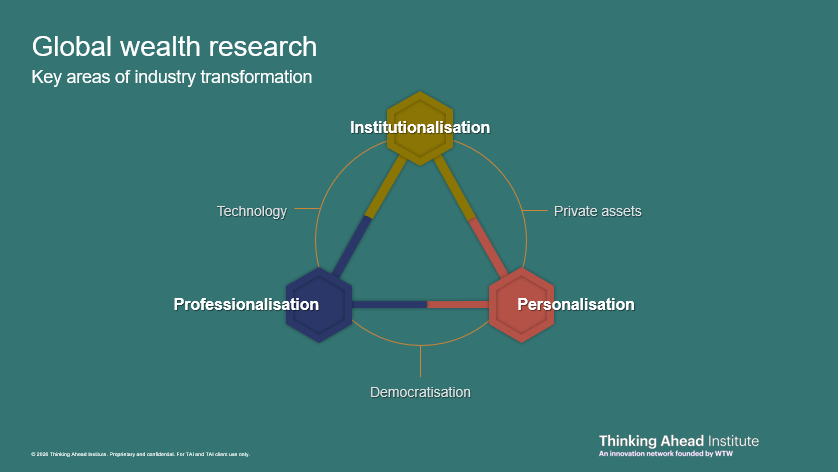

We were thrilled by the engagement and feedback on our Global Wealth Study last year. Building on that momentum, we’re tackling the forces reshaping wealth management from institutionalisation to personalisation, as technology and private markets accelerate change. This is a defining moment for wealth – let’s shape it together through shared research, SHAPERS dialogues, or collaborative thought leadership.
Andrea Caloisi
Researcher, Thinking Ahead Institute
Explore our wealth research here
We have taken key findings from our Global Wealth Study and are exploring a series of questions grouped by four key themes, through the lens of the three-part framework above:
| Theme | Findings from Thinking Ahead’s GWS 2025 | 2026 research exploration |
| Technology | One-third view investment platforms and technology most valuable for wealth transfer One-third foresee difficulties keeping pace with technology and digital transformation | How will tokenisation, digital assets and AI reshape wealth management portfolios and advisory models? |
| Private markets | Private assets already make up 20% of wealth portfolios in this sample Private markets sit firmly in the investment opportunity set, ranked top after tech | What innovations or product design features could help mitigate the disproportionate risks and challenges posed by cost, liquidity and transparency? |
| Whole-of-life | 60% cite capital accumulation as their leading wealth priority, ahead of other life goals | Does a whole-of-life, whole-balance-sheet approach significantly increase value by complementing the wealth-growth drive identified in the study? |
| Talent and skills gap | 40% expect talent attraction and retention to be their top challenge over the next 2–3 years | What new skills will be essential for wealth professionals? How can firms attract, develop, and retain talent in the competitive global wealth market? |
Please contact Andrea Caloisi to know more.
Related pages
Total Portfolio Approach
Our work on the Total Portfolio Approach (TPA) will continue through projects with asset owners and asset managers, while also advancing its practical application across the wider industry.
Our focus is on three tools within TPA: the sandbox, the guardrails and the gateway.
Sandbox: a protected environment for creative experimentation, where TPA thinking can be tested, challenged and refined.
Guardrails: a well-governed framework that enables new ideas to progress safely and with discipline.
Gateway: the point at which the flexibilities enabled by TPA allow organisations to shape a more integrated investment approach.
These three elements capture not just the evolution of our Thinking Ahead research, but also how TPA is maturing in investment organisations- from experimentation, to structured discipline to genuine organisational transformation. And they also capture quite neatly some of the ways we work directly with organisations on TPA.
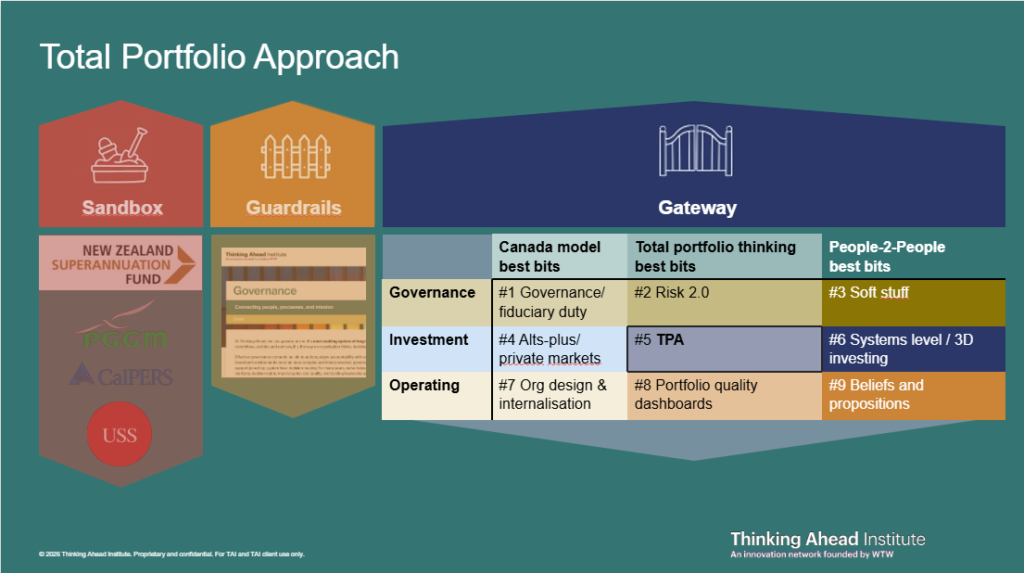

TPA is a journey from creativity to discipline to integration, and it’s been a privilege to continue our work with organisations on TPA all at different stages in the process. If you want to understand how your organisation could start or develop its TPA journey we would be happy to help.
Marisa Hall
Head, Thinking Ahead Institute
Explore project case studies on our TPA hub
Key resources

Why now is the time to adopt the total portfolio approach. View the PDF.

A practical guide to implementing total portfolio approach. View the PDF.

Visit our TPA hub
Take our new quiz: Is your organisation more SAA or TPA?
Please contact Jessica Gao to know more.
Related pages
Long term thematic trends and other investment insights
The thematics workstream, in collaboration with WTW, will examine enduring structural forces that shape economies and markets over long horizons. These themes provide a unified framework for identifying where risks and opportunities are positioned and how markets are pricing them.
From a Total Portfolio Approach perspective, these themes establish a common language for evaluating risks and opportunities across asset classes and portfolios.
The core themes identified by WTW span Innovation, Conflict, Nature and Climate, Longevity, and Debt, with sub-themes at the intersection of multiple themes.
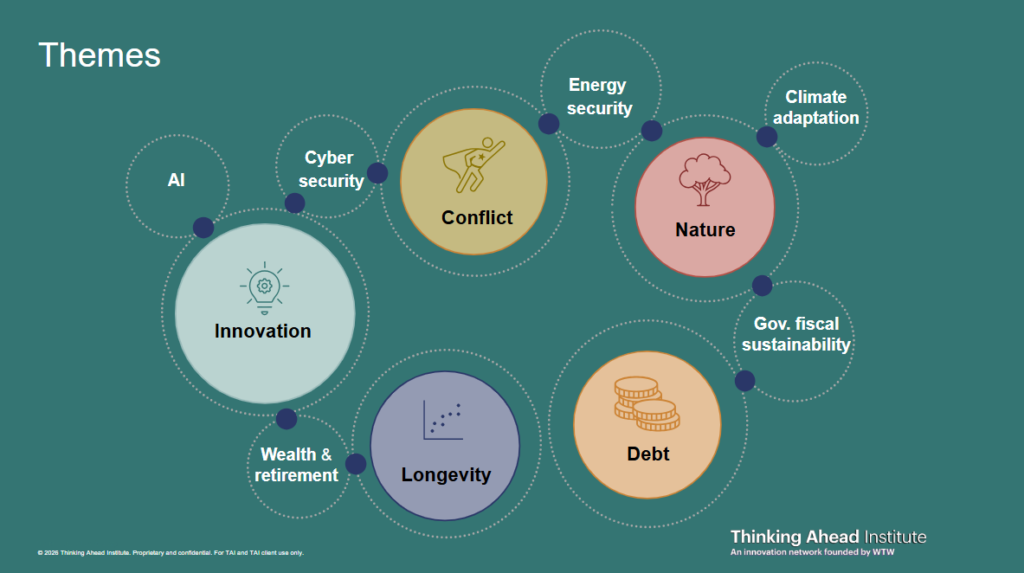
We will also publish a series of thought pieces covering a range of topics from our research streams to broader, more lateral themes.
Proposed topics for the year include:
- Has the correlation between equities and bonds fundamentally changed?
- Is diversification still valuable for long-term investors?
- Is diversity more or less valuable now?
- Are private assets attractive for the next 10 years?
- How might AI affect the above answers (and other questions)?
- Might there be a relationship between the changing structure of pension provision and the vibrancy of the economy?
- How might blockchain and/or tokenisation change investing?
- What is the next generation of smart indices?
Explore our Library or contact Andrea Caloisi to know more.
Related pages
Industry survey & peer groups
TAI has previously conducted the Global Asset Owner Peer Study, and a Global DC Peer Study. In 2026, we are looking to expand our work through a series of new studies given below:
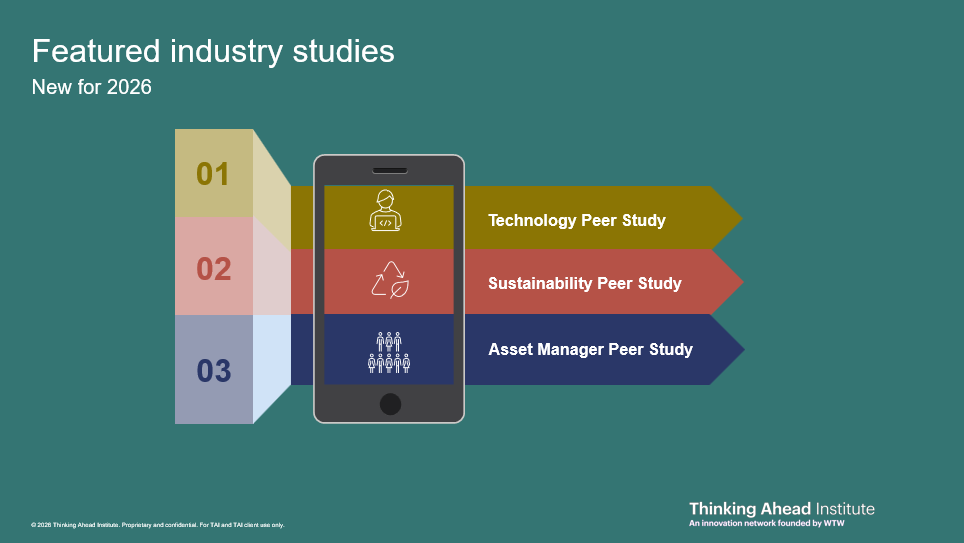
Currently, scale is driving changes in market structure, from mega funds to pooled models. For large organisations, the challenge is managing complexity. For those on a growth journey, it’s about understanding the path to scale. And for others, the key is accessing the benefits of scale without having to become big.
Studies will explore how organisations leverage scale across three dimensions: alpha, beta, and organisation, to enhance investment capability, governance, and innovation.
Alpha
- scale in skill-based strategies
- access to private markets
- specialist teams
- monetising skill
Beta
- broader market access
- dynamic beta
- thematic tilts (eg demographics, climate, tech)
- benchmark innovation
Organisation
- internalisation & internationalisation
- organisation maturity model
- governance as organisation grows
- fund structure & pooling model
- technology adoption & integration
We will continue releasing our acclaimed industry studies, which are among the most cited and widely read WTW investment reports. Explore our latest editions below.

Our global studies attract thousands of downloads and widespread media coverage, helping shape industry debate. We partner with organisations to co-create research, such as our gold feature in the Global Pension Assets Study exploring gold’s role in portfolios. If you’d like to explore a research collaboration or partnership, please get in touch.
Anastassia Johnson
Researcher, Thinking Ahead Institute

World’s largest 500 asset managers

Global top 300 pension funds
Ranks the top 500 asset managers; latest edition will include a dedicated section on the role of AI and tech
Tracks the world’s largest pension funds, highlighting asset growth trends and sovereign fund rankings

Global pension assets study

The Asset owner 100
Offers a comprehensive analysis of pension assets across 22 global markets, with deeper insights into the seven largest ones
Ranks the world’s largest asset owners, featuring a new section focused on alternative investments in the latest edition
Explore our 2025 Impact and Influence Review for an overview of the reach of our global studies.
Related pages
Doing projects with Thinking Ahead
We love the opportunity to engage with organisations on projects tailored to your needs.

Here are some examples of projects we have done so far:

Review governance design and compare with a best practices model
Focus areas:
Risk 2.0
Fiduciary duty
Org design
Assess current investment framework to enhance TPA thinking and practice
Focus areas:
TPA spectrum
Investment model
Joined-upness
Beliefs review to reflect evolving priorities, remain practical and compare with peers
Focus areas:
Balanced scorecard
Org alpha
Portfolio construction
Optimise alternative investments; higher allocations, greater diversity, and strengthened partnerships
Focus areas:
Asset allocation
Resourcing
Risk drivers

Soft stuff is the hard stuff; align organisational superpowers through collaboration and systems thinking
Focus areas:
Culture & Superteams
HI x AI
Talent
A SWOT (Strengths, Weaknesses, Opportunities, Threats) dashboard for asset managers to assess how well organisations are positioned to navigate current and future industry challenges.
Combining public data, AI-enabled analytics, and survey insights, the dashboard will deliver a comprehensive, forward-looking narrative for each organisation.
Focus areas:
Strategic resilience
Innovation and digital capability
Sustainability and stakeholder alignment
Talent and organisational agility
To schedule your project this year, email us
Our working groups
Each year we convene several invitation-only working groups. This year we’re launching our ‘2.0’ series – a suite of upgraded frameworks across Investment, Governance, Risk, Sustainability, Technology and the Professional, with an emphasis on systems thinking and embracing complexity.
First up is our C-suite Technology Ecosystem Working Group, tackling one of the defining questions for investment organisations right now: how technology, human intelligence and AI are reshaping decision-making, governance and organisational design. Running from April to July 2026, the group explores four interconnected themes:
- Technology ecosystem: are current data and measurement frameworks fit for purpose, and what can emerging technologies (including AI) do to close the gaps?
- HI × AI: how do human and artificial intelligence best complement each other, including the intersection with TPA adoption, and what are organisations actually solving for: decision accuracy or decision velocity?
- Investment Process & Intelligence Stack: how does technology connect to real investment outcomes, specifically its impact on value-add, and who wins or loses as decision-making becomes more technology-driven?
- Bringing it all together: how do these pieces combine at the organisation and individual levels, covering future skills, governance, and the right balance between technology spend and investment spend.
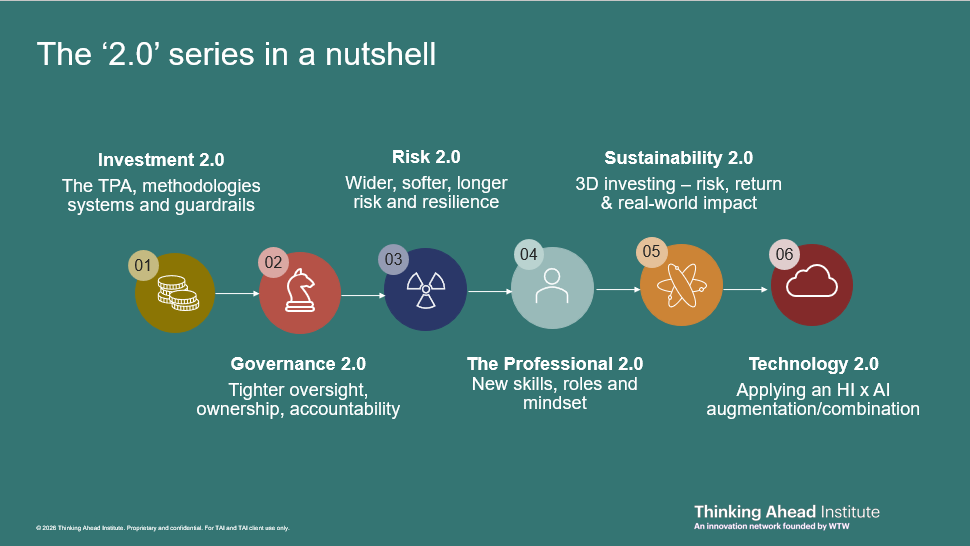

As Bob Dylan put it, the times they are a-changing. In the tension between ‘same as ever’ and ‘different this time,’ it’s clear that much more is different now. What we need is a 2.0 upgrade across multiple dimensions. Not reinvention, but evolution. The core architecture still stands, but its expression must be more integrated, more dynamic, more resilient, and fully aligned with the new conditions we face.
Roger Urwin
Co-founder, Thinking Ahead Institute
Get in touch to know more.
| Framework | What is it? | How is it different from 1.0? |
| Investment 2.0 | The TPA system, methodologies and guardrails | Allows for complexity, non‑linearity and high‑noise system features using goal‑driven processes and multiple comparator measurements, versus the narrow SAA discipline using benchmarking that assumes a linear, stable, low‑noise system. |
| Governance 2.0 | Tighter oversight, ownership, accountability | Governance designed for better outcomes through optimal risk practices, strengths and smart goals, versus governance focused on measurement and career‑risk friendliness, making it clunky. |
| Risk 2.0 | Wider, softer, longer risk and resilience | Risk framed through systems thinking lens accounting for regimes, systemic risk, resilience, uncertainty, term structure, fallibility and reflexivity versus risk framed narrowly as (stable) volatility and correlation using CMAs and optimisation. |
| Sustainability 2.0 | 3D investing – risk, return & real‑world impact | Allows two‑way feedback between the wider ecosystem and investment strategy and stewardship with explicit time‑frame consideration, versus ESG sustainability where portfolio risks and returns are central. |
| Technology 2.0 | Applying an HI × AI augmentation/combination | Design, supervision and application of HI × AI‑generated insights via re‑engineered workflow, role resets and agentic interventions in hybrid decisions, versus well‑informed but discretionary and intuitive HI processes. |
| The 2.0 Professional | New skills, roles and mindset | Adapting to the HI × AI proposition and T‑redesign with Pi features through greater ownership, measurement and accountability, versus the strong verticals model of the past. |
Related pages
Pensions aren’t what they used to be… a glimpse into the future
The Power of Teams
Risk 2.0: The wrong type of snow