Roger Urwin’s annual holiday reading list is here! As always, Roger has gathered a thoughtful selection of books that caught his attention this year—spanning fiction, non-fiction, and everything in between. Whether you’re hunting for stories that challenge your thinking or simply want to know what’s worth reading, his recommendations have become a trusted seasonal tradition. See what has made the cut this year.
Everyone has a happy place—mine falls into two categories: snowy or beachy. This is my winter version: relaxing by a cosy fire with my book, finally enjoying a break from peak busy (and with apologies to the 12% of you in the southern hemisphere).
This note is a bit more than about books. Text consumption comes in many forms and includes listening to audiobooks and podcasts, reading papers and posts, and even looking at AI book summaries at every level of granularity – zooming in or out. But they all share a give and a get. You give the time and the thinking, and you get the dopamine hit from learning and the growth from being a tad smarter. Your neuroplasticity fires up. You strengthen your neural pathways (more from non-fiction), and build empathy (more from fiction), sharpen your critical thinking and increase your focus.
It is a scientific fact that reading accelerates the growth of your mind. You engage memory through the hippocampus that stores what you’ve read. And here’s the best bit: when you encounter new information, your brain matches it to your existing ‘schema’ – the mental models and organising frameworks where new stuff is sorted and it’s added to your intelligence. This is the place where you keep a working model of the outer world, the intricate sense of your inner self, and also the means to re-set your work-relevance in a post-AI world.
And that might be the help we need to adapt in particular to a fast-changing world of work. In this future do we need same as ever skills or different this time skills. I believe we need both but it adds up to a skills re-set as below. The artwork is from my oldest granddaughter Annaka who is 12. She is my T-shaped apprentice on this.
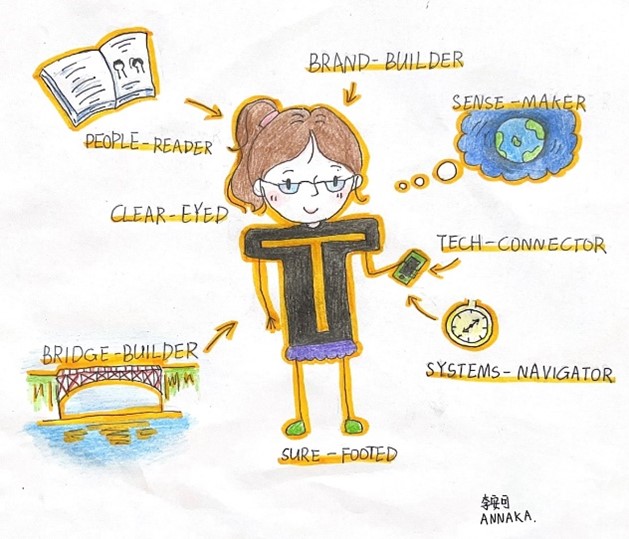
What’s new here then? She is T-shaped, clear-eyed and sure-footed but that’s the same as ever. Remember that T-shaped people have deep domain skills in the vertical and wide connecting skills in the horizontal.
What about people-reading, brand-building, and sense-making? These have always mattered; they are more important now.
But it’s different this time with the other three: bridge-building, systems-navigating, tech-connecting. These are seriously bigger deals for success in future work-lives. With bridge-building I’ve previously talked about the increasing power of combination that Matthew Syed covered in Rebel Ideas. We are so much stronger together than on our own.
Ecosystems are dominant factors in all our lives – the organisations we work for, the networks that shape us, and so on, and being able to navigate them allows us to make the best of their potential.
And technology is speeding up with AI startlingly powerful and our connections there are defining factors in our work lives.
All this has been on my mind this year. And this re-set of skills has resonated with people. They’ve asked how they can develop these skills. One of the key answers is clear: choose your reading to develop them.
| Bridge-builder | Building strong and influential personal and corporate coalitional relationships in which mutual trust is central |
| Systems-navigator | Building situational fluency in all of the multiple ecosystems you inhabit – your organisations, etc |
| Tech-connector | Ability to enable magic things to happen with technology driven by the HI (Human Intelligence) x AI combination |
| Sense-maker | Making sense of the world at the zoomed-out and zoomed-in levels driven by critical and systems thinking |
| Brand-builder | Developing personal brand growth and living the corporate brand driven by strong identity and authenticity |
| People-reader | Fluency with EQ and soft skills driven by growth mindset, inquisitiveness and empathy |
December 2025 reading suggestions
Bridge-building
How to Win Friends and Influence People by Dale Carnegie
Are you serious? This is such an old book. Yes, first published in 1936, and it has sold 30 million copies, but take a look if you haven’t, it’s good. This is a foundational text on interpersonal skills and influence. It is so widely read you can drop it into discussion really easily. Carnegie distils decades of experience into practical principles for building rapport, resolving conflict, and motivating others. The book is structured around showing genuine interest in others, remembering names, being a good listener, and making people feel important – not rocket science, but not common. The updated edition corporate digital communication, remote teamwork, and multicultural workplaces. This is about how to build bridges and be an effective leader.
The Culture Code by Daniel Coyle
Coyle investigates what makes groups successful by examining a range of high-performing teams, from elite military units to innovative companies. He identifies three key skills: building safety, sharing vulnerability, and establishing purpose. The book is particularly good with real-world examples and actionable strategies, and the evidence trail is good. It’s grounded in research from psychology and neuroscience. Thinking Ahead continues to do research on culture and suggest the place for Superteams. This helps the toolkit for producing that crucial triad of safety, sanity and flow in the cultural condition.
Systems-navigating
Making Sense of Chaos by Doyne Farmer
Sensemaking confronts complexity and uncertainty growing at super-exponential rates. Farmer is a ‘Thinking Ahead hero’ – formerly at Santa Fe, now at Oxford INET. This is about the science of complexity, exploring how chaotic systems—such as financial markets, ecosystems, and weather—can be understood and, to some extent, predicted. He introduces key concepts from mathematics and physics, such as nonlinear dynamics and feedback loops. This is suggesting – a bit optimistically IMO – that we can embrace uncertainty and complexity as opportunities for innovation and adaptation.
Beyond the 80-20 Principle by Richard Koch
Building on the 80-20 Pareto Principle, Koch explores how a small proportion of causes often lead to a large proportion of results. He’s good in the inter-disciplinary area where we could all use a bit more T-shapedness. I have found the Heisenberg principle a good leaf out of the physics textbook to explain reflexivity in investing. And the second law of thermodynamics (entropy increases) comes in as the metaphor to explain why most efforts yield little result and why without focus, systems (including organisations) naturally become more muscle-bound and chaotic.
Tech-connecting
All Over the Map by Betsy Mason
Sensemaking from another perspective. This visually stunning (and expensive) book is on the art and science of cartography, featuring a diverse collection of maps from history and the present day. I’ve been brought up on Charles Minard’s wonderful infographic of Napoleon’s wildly unsuccessful campaign on Moscow in 1815. This is dripping with fabulous examples through the ages telling stories, using data, embedding theory. Mason explores reveal hidden patterns and shape our understanding of the world. This is new perspectives and creative communication on steroids.
A Brief History of Intelligence by Max Bennett
Bennett traces the development of intelligence from its biological origins to the rise of artificial intelligence. He examines how intelligence has evolved in animals and humans, the mechanisms behind learning and problem-solving, and the implications of AI for society. The book blends science, history, and philosophy to explore what it means to be intelligent and how technology is reshaping our understanding of the mind. It does a really good job on the evolution of intelligence to present-day AI and implications for the future of work and society. In the AI era, we need to understand this word ‘intelligence’ much better. We need to make the HI x AI, human intelligence times artificial intelligence, the centrepiece.
Brand-building
Stand Out by Dorie Clark
Clark’s book is a guide to developing a distinctive personal brand and becoming recognised as a thought leader. She outlines steps for identifying your unique strengths, building a following, and leveraging expertise to create impact. The book helps readers clarify their message, expand their network, and gain visibility. Clark emphasises the importance of authenticity and persistence in standing out in a crowded marketplace. The thought leadership parts are the most relevant to Thinking Ahead – and her views overlap with mine in seeing this as thinking that influences, innovates and produces differentiated brand.
Digital Branding: How to Successfully Build a Brand Online by Daniel Rowles
This is the best book I could find in the Me 2.0 area and reminds me of all the things that I’m not finding time for. That takes me back to the Power of Habit by Charles Duhigg and Atomic Habits by James Clear where I love using my triad of habit stacking, habit tracking and systems backing. This book is focused on building and optimising your brand identity across digital channels. The examples from leading organisations like PwC and BBC, are good with career management aspects covered. It helps with an answer to a question that many of us should ask – is your brand authentic, bold, credible, and digital?
Sense-making
Nation Apart by Colin Woodard
In sense-making, this is good. It’s basically past is prologue stuff. It certainly helped me with understanding US polarization issues. Woodard explores the deep-rooted cultural and historical divisions that define modern societies, particularly in the United States – he’s American. He traces the origins of regional identities and examines how these differences influence politics, economics, and social attitudes. He shows how tough these unity and division issues have grown to be. My summary. With the past as prologue, and the present so fleeting, the future is for forging. Factoid from Dorie Clark: 97% of business leaders rank long-term thinking as important, 96% have difficulties finding time for long-term strategy.
Why We Sleep by Matthew Walker
This book is a wake-up call. 😊 I need more sleep. This is sense-making for that third of our lives that none of us truly ‘get’. Just one night of poor sleep can decrease your learning capacity by up to 40% (mostly because you forgo the last and most valuable cycle of the night). Growth mindset people you don’t want that. Walker, a neuroscientist, presents the latest scientific research on sleep and its critical role in health, learning, and productivity. He explains the stages of sleep, the consequences of bad sleep and lost sleep, and the benefits of good sleep practices and practical tips for improving sleep quality.
People-reading
The Three-Body Problem by Liu Cixin
At last, some fiction. This 30 million seller science fiction three-book novel begins during China’s Cultural Revolution and follows a series of mysterious events that lead to first contact with an alien civilisation. The story weaves together physics, philosophy, and political intrigue, exploring themes of scientific discovery, existential risk, and humanity’s place in the universe. The novel is renowned for its imaginative scope and intellectual depth. There are a lot of people hooked on this. My consumption has only reached the Netflix version which was amazing – full disclosure. This is about the creative exploration of complexity, systems thinking, and the unknown.
Hamnet by Maggie O’Farrell
Fiction again. This has turned into a big new film out in early January. Inspired by the life of Shakespeare’s son, but it’s a fictional account, you might have expected it to be more about Shakespeare as a playwright but it is more a moving narrative about love, loss, and creativity. O’Farrell brings Elizabethan England to life, exploring the personal tragedy’s impact on artistic expression. The narrative shifts between the perspectives of Hamnet’s family members looking in on grief and resilience. This is a beautifully written novel.
Roger’s most recent reading lists:
Postscript. On finding time to read, the work answer I think is to discipline the mix of BAU (business-as-usual) and BBU (business-beyond-usual) time. This for me is the 20% ‘bucket’ for BBU. My life answer is the same. My LAU (life-as-usual) bucket is overflowing, and I need a 20% LBU (life-beyond-usual) allocation to keep my sanity. Sadly that budget got squeezed in 2025. A good example was trying to read Why we Sleep at bed-time. Guaranteed sedative, ha. I’m ready for a sleep biohack next year.
May you have a great Holiday Season (OK Christmas) with a brilliant mix of rest and recreation, and social and solitude time, and life-as-usual and life-beyond-usual time. May you read sage bait not rage bait and as a result excel at aura farming and find new words to add your vocabulary. This year I have continued to seek out new and old books with new and old words that respect the world as a wider, deeper, and softer place than we give it credit. And below is the full list of books that I’ve curated over the years with a bit of narrative to help with priorities. With a big credit to all those who have contributed their ideas. Not least to Gail, my kids and grand-kids who figure in my 2-8-13 pin-code.
| BOOK SUGGESTIONS SUMMER 2025 | |
| Sean West | Unruly. Herewe have the concept of the unruly triangle—the intersection of: Politics, Artificial Intelligence (AI) and Law. These forces, once managed separately, now collide in unpredictable ways, creating compounded risks that traditional business strategies don’t handle at all well. West documents a global decline in the rule of law. AI technologies like deepfakes and misinformation tools erode trust in truth itself. So not good news. |
| Walter Isaacson | Elon Musk. I read this when Musk still had a good personal brand. Now that’s gone it helps me understand the good, the bad and the ugly with him and the likely destructive part he will play in our future. |
| Rob Orchard | An Answer for Everything. Infographics to explain the World. This is creative sensemaking brilliantly synthesised. Infographics are more than informative; they are dead cool, and infographic experiences are getting better with AI. |
| Alex Edmans | May contain lies. We live in a world full of misleading stories, flawed statistics, and biased studies and our cognitive biases make us especially vulnerable to believing them. We are being hacked constantly, we tend to accept information that confirms what we already believe (confirmation bias). We often confuse correlation with causation. We overdo emotion (System 1 thinking, per Kahneman). We undercook rational analysis (System 2). Etc, etc. |
| Brianna West | 101 Essays that will change the way you think. One beautiful excerpt: the essay on ‘experiences we don’t have English words for yet’. When sunlight shines through trees, the interplay between the light and the leaves. It’s an awesome, well, experience. In Japanese there is a word for it, it’s “komorebi” (木漏れ日). And then another excerpt: the inability to grasp the fact that we can’t grasp what we don’t know yet. ‘101 Essays’ is great quirky writing. |
| Naomi Oreskes | The Collapse of Western Civilization: A View from the Future. This essay is a science-based narrative written from the perspective of a future historian in the year 2393, looking back at the period between 1988 and 2093. It explains how Western civilization failed to act on increasingly alarming scientific warnings about climate change, leading to catastrophic consequences. Maybe, just maybe we are sleepwalking towards a date with destiny on climate change. |
| Roman Krznaric | The Good Ancestor. We prioritize immediate rewards over long-term consequences. This short-termism is reinforced by technology, consumerism, and political systems. So, the big asks are to step up on intergenerational justice: ensuring fairness for future generations; apply cathedral thinking – starting projects that may take generations to complete (think Sagrada Familia and Gaudy). |
| Josie Silver | One Day in December. This is a languid novel exploring fate, timing, friendship, loyalty, and honesty and how life rarely unfolds the way we expect. This is actually best read, or maybe listened to as I did, in the run-up to Christmas. I am not a great fiction reader, but this was a really top experience. |
| BOOK SUGGESTIONS 2024 | |
| Andy McAfee | The Geek Way. This is about the Silicon Valley ecosystem and how a small number of companies have grown to be as big as countries through their culture of science, speed and openness. i.e. culture eats strategy for breakfast. The read across from this to wider principles on success is resonant, this is about smarter balanced score-cards, more accurate attribute of decision ownership and a better speed of growing intelligence |
| William Donaldson | Simple Complexity. Systems thinking is a beguilingly simple but paradoxically complex way of approaching work, life, the universe. This explains things really well and is the companion to the Peter Senge Fifth Discipline account |
| Brene Brown | Dare to Lead. This is humble, honest and inspiring. ‘Stay curious keep showing up’; and “Vulnerability is not winning or losing. It is having the courage to show up when you can’t control the outcome’. Full of wisdom |
| Matt Lucas | The Boy who missed Christmas. Nice feelgood stuff for young readers, best done in audio read by Matt Lucas himself |
| Graeme Simsion | The Rosie Project. The brilliant but socially awkward professor who uses a scientific survey to find a wife only to fall for someone who defies all his criteria. Has a nice effect on readers – getting you more comfortable with your self |
| B. J Novak | The Book with no Pictures. Pretty silly stuff. That’s the point. Wonderful way of engaging with kids on their terms. This is one of those ‘magic’ things – what is the secret sauce? Kids love this book |
| BOOK SUGGESTIONS 2023 | |
| Peter Senge | The Fifth Discipline. Peter Senge has produced a timeless classic here. The first four disciplines are personal mastery, mental models, building shared vision, and team learning. And systems thinking the fifth – integrates the other four. |
| Mustafa Suleyman | The Coming Wave. The content here is a combination of deep thinking on AI and synthetic biology and these two ‘will usher in a new dawn for humanity, creating wealth and surplus unlike anything ever seen’. Maybe |
| Francis Fukuyama | Liberalism and Its Discontents. This book is aimed at explaining how modern liberalism has increasingly underdelivered, and how populism has entered our world by filling a gap and can only grow |
| Ayelet Fischbach | Get it Done. Drilling deeper into human cognition continues to surprise. There are a lot of secret sauce things she reveals here in the dynamics of goal pursuit and aligning our choices, decisions, and feelings. |
| Kahneman, Sibony & Sunstein | Noise. I share the thesis here which is that noise in human judgment is everywhere, notably via cognitive biases, mood, group dynamics and emotional reactions. And it’s consistently under-estimated. |
| Dan Ariely | Misbelief. The world isn’t fully post-truth, but truth has been on a slow bleed for sure in the past decade or so. The link with social media is overwhelming. What he calls ‘the funnel of misbelief’. |
| Mitch Albom | The Five People you meet in Heaven. This is a feelgood light read that explores the alternative histories that our lives produce, and the people caught in the connections, like in the film Sliding Doors. |
| Susan Cain | Quiet. The power of the introvert in a world that can’t stop talking. This feels good because we can cut ourselves some slack by being on the quiet side of the line in a world where overwhelmed with noise. |
| BOOK SUGGESTIONS 2022 | |
| Azeem Azhar | The Exponential Gap This book covers the ‘exponential gap’ between the power of new technology and humans’ ability to keep up. I worry about the speeding up in speeding up and its consequences in our degraded environment, fast-moving social problems and cyber risks. Basically, we need to shape technology to put it back in the service of society. That is becoming so evident with AI’s super-exponential growth. |
| Susan Cain | Bittersweet. How sorrow and longing make us whole This book got me both into a darker place before emerging into a lighter place. This book helps you into places ‘where light and dark meet’ and into spaces that are more sensitive, creative and spiritual. And in reflecting on that, yes that did reduce my weltschmerz. (A reminder: Weltschmerz is literally world grief, but it’s better in German |
| Lynda Gratton | Redefining Work As we develop our new way of working with hybrid arrangements, we need to get up to speed on the future of work. I found the audio version of this book easy to absorb and well-framed. The pandemic has given us some silver linings, our work future is one of them. Re-reading this after the pandemic, it has lasted very well |
| Kim Stanley Robinson | The Ministry for the Future. This is fiction with a bit of non-fiction thrown in. KSR is well-known for science fiction which is a fast-paced thriller plotline weaving in climate change, geo-engineering, politics, and societal futures. In a world needing imagination on climate change this is both realistic and optimistic |
| Vaclav Smil | Numbers don’t lie | 71 things you need to know about the world. The book title drew me in. But Vaclav Smil is a renowned Czech-Canadian scientist and policy analyst with tremendous understanding of our inter-connected world and the book is an easier read than you’d think. And if you like this, you will also like How the world really works. |
| Gaia Vince | Nomad century. How climate change will reshape our world. This is a tough read, so be careful. But my ‘Weltschmerz’ (literally ‘world pain’ that the realities of life are grim because of too much suffering and evil) finds an outlet in reading this in understanding this century’s future blighted as it is. It remains a beautiful world. This is a highly imaginative account of the world we are creating. The idea that rising sea levels, extreme heat, droughts, and ecological collapse will force billions of people to move from uninhabitable regions – mostly from Africa – to more temperate zones is so evident, but so not in people’s imagination. Climate issues are already significant in migration issues right across Europe and can only grow over time. |
| 2018-2021 BOOK SUGGESTIONS | |
| Beinhocker, Eric | The Origin of Wealth* |
| Berners Lee, Mike | There is no Planet B*** Highly readable account of climate change mixing science and economics to help suggest solutions that everyone can contribute towards. This book is ground-breaking in putting our values under scrutiny and into the mix with support for the importance of kindness and fairness |
| Bernstein, Peter | Against the Gods: The Remarkable Story of Risk* |
| Bookstaber, Eric | The End of Theory* University of California Chief Risk Officer Bookstaber, explains the nature of systemic risk and what happens in crises, like the GFC, when systems seize up, and how agent-based modelling can address some of the issues. The failings of economics are an essential theme |
| Brynjolffson & McAfee | Machine, Platform, Crowd** This book is a very clear introduction to the new technologies that are disruptive given scale and need and suggests where industry business models will undergo their Uber-moments, usually when platforms and networks break through |
| Carney, Mark | Values: Building a Better World for All*** This is a well-framed and researched book about society adapting its goals to suit its values in a world in which financial value has out-muscled non-financial values. It is particularly strong in showing how to learn from the pandemic through principles of solidarity and fairness |
| Dalio, Ray | Principles** Controversial account of how organisations can be simplified into machines with equations that might be seen as de-personalising. But Dalio is a huge fan of culture and talent and his radical transparency model works for Bridgewater where decisions are fine-tuned by ‘believability’ |
| Desai, Mihir | Wisdom of Finance* |
| El Erian, Mohamed | When Markets Collide |
| Fukuyama, Francis | Identity* |
| Friedman, Thomas | Thank you for Being Late |
| Gawande, Atul | Checklist Manifesto* |
| Gladwell, Malcolm | Tipping Point |
| Gladwell, Malcolm | Outliers |
| Haidt, Jonathan | The Righteous Mind** Haidt reveals the soft nature of our belief system in which feelings come first, socialising second, thinking third. His identification of individuals flags the moral foundations in core values of caring, fairness and loyalty in groups. He identifies libertarian principles as innate to individuals |
| Harari, Yuval Noah | Sapiens |
| Harari, Yuval Noah | 21 Lessons for the 21st Century** This is a stunning tour de force across work, equality, civilisation, nationalism, religion, immigration, war, post-truth, education and meaning; and a few more.All it misses is global pandemics. ‘Clarity is power’ is key and he identifies pathways to the redesign of life itself |
| Harford, Tim | How to Make the World add Up | Ten Rules for Thinking Differently About Numbers** Harford is of course the ‘Undercover Economist’. The steady erosion of standards in the presentation of facts and numbers has meant this book has become essential. Search your feelings, get the back story and be curious and other principles are well-presented and illustrated |
| Hastings, Reid & Meyer, Erin | No Rules Rules: Netflix and the Culture of Reinvention |
| Heimans & Timms | New Power |
| Henderson, Rebecca | Capitalism Reimagined in a World on Fire** A book preaching the importance of fairness in business and society, strong institutions, and a guiding purpose and synthesised into how businesses can make these changes themselves and through collaboration. Lots on climate change and inequality. It is overly optimistic though |
| Ilmanen, Antti | Expected Returns* |
| Kahneman, Daniel | Thinking Fast and Slow* |
| Kay, John | Other People’s Money |
| Kay & King | Radical Uncertainty |
| Kerr, James | Legacy – 15 Lessons in Leadership* This all about the All Blacks. Really good descriptions |
| King, Mervyn | The End of Alchemy |
| Lo, Andrew | Adaptive Markets* |
| Lovegrove, Nick | The Mosaic Principle |
| Malhotra, Deepak | The Peacemakers Code** Malhotra is the Harvard Business Professor in negotiation, deal-making and conflict resolution who turns storyteller in this science fiction about alien invasion. The story is fast-paced fiction and has significance for society’s ability to face up to existential challenges through co-operation |
| Mauboussin, Michael | More than you Know |
| Mayer, Colin | Prosperity* |
| Mazzucato, Mariana | The Value of Everything; Making and Taking in the Global Economy* |
| McGrath, Rita | Seeing Around Corners; How to Spot Inflection Points in Business Before They Happen** This is about the build-up in disruptions and how assiduous attention to factors at play in disruptions helps with prescience. The methods generate scenarios that enable organisations and individuals to pivot more quickly and join the disruptors and avoid being the disrupted. |
| Moyo, Dambisa | How Boards Work: And How they can Work Better in a Chaotic World |
| Mulgan, Geoff | Big Mind |
| Page, Scott | The Diversity Bonus |
| Pink, Dan | Drive: The Surprising Truth about What Motivates Us* |
| Pinker, Steven | Enlightenment Now |
| Raworth, Kate | Doughnut Economics*** Doughnut economics, is a visual framework for sustainable development – shaped like a doughnut or lifebelt – combining planetary boundaries and social boundaries and providing a framework for how different parts of our ecosystem can contribute to a sustainable future |
| Rosling, Hans | Factfulness* |
| Silver, Nate | Signal and Noise* |
| Stout, Lynn | The Shareholder Value Myth |
| Suskind, Daniel | The End of Work |
| Syed, Matthew | Rebel Ideas*** This is in the Malcolm Gladwell genre and explains through story-telling how teams can accomplish more than individuals but all too often fail in cognitive diversity by not using multiple frames of reference. The merits of dominant and prestige (servant) leaders is telling |
| Taleb, Nassim Nicholas | Fooled by Randomness** An accurate account of the part played by noise in life, industry and investing. In this work he writes clearly on the part played by cognitive dissonance in seeing soft data as gospel; and the part played by unexpected events (black swans) and radical uncertainty as later picked up by Kay |
| Tegmark, Max | Life 3.0** This explains the future of AI from its current applications to massive extensions and on to generalised AI and the consequences in terms of the singularity. It is aimed at keeping AI constructive to our humanity but leaves a few doubts as to whether AI can stay a benign force |
| Tippett, Krista | Becoming Wise; An Inquiry into the Mystery and Art of Living* |
| West, Geoffrey | Scale* |
| Top 5 Next 10 Next 20 Next 15 | ***= don’t even think of not reading this **= required and essential reading *= essential reading = plain good reading |
Explore our website
- Take a look at our 2026 research activities and events
- Look back at our Research Index and explore topics of interest to you and your organisation
- Curious about joining us? Find out more.
- Join our Annual Briefing event | Wednesday 4 February