
Executive Summary
ESG integration and engagement in liability-driven investment (LDI) and money market funds (MMF) is coming into focus for asset owners. Asset owners are exposed to credit risks of trading counterparties, which recent history shows are impacted by ESG risks. ESG screens used by asset managers do not capture long-term risks adequately. We also feel that credit rating assessments of ESG risks are relatively short term. Engagement with counterparties to mitigate these risks is therefore key. To tackle this issue, we have developed a framework to help asset owners when considering ESG risks and reviewing counterparty engagement in LDI and money market funds.
Introduction
ESG integration in LDI and MMFs has not been centre stage for asset owners, despite comprising a large portion of asset owner portfolios. This has partly been because frameworks for evaluating sovereign bonds, derivatives and short dated securities have been or remain a work in progress.
We believe certain ESG risks need to be carefully managed as they can translate into financial risks more quickly than expected. We have advocated managers give careful consideration to ESG and engagement for a long time.
In this paper, we set out a suggested framework for asset owners when considering ESG risks and engagement in LDI and MMF mandates.
The nature of the risks
Part of the problem of incorporating ESG into LDI mandates has been the nature of the underlying holdings such as government bonds, derivatives and short-dated securities with corporates, and typically large and high credit quality banks.
- Sovereigns are discussed in further detail below. Managers may choose to invest in labelled ESG bonds, for example green bonds, however the market is still relatively new and challenges remain.
- We note guidance on how to treat derivatives for climate and other ESG-related disclosures is still a work in progress. Asset owners may choose to report emissions numbers separately (with and without derivatives, as well as long versus short) where feasible to help give the end-user the full picture.
- The securities issued by financial institutions in MMFs are very short, which limits the likelihood of ESG risks developing in the time to maturity. However, pension funds are exposed to the business activities (and the credit risk) of these institutions on a rolling, long-term basis.
Guidance on sovereign engagement and emissions reporting
We support the PRI’s recommended framework for engaging with sovereign issuers and expect asset managers to be engaging with government bodies as part of their regular stewardship activity and industry engagement. We strongly encourage managers to define clear engagement policies but recognise escalation with a sovereign may be difficult in the context of derivative-based mandates, as the ultimate escalation tool of selling government bonds (and other eligible collateral) is rarely an option.
In the UK, pension schemes over a certain size are required to report on a range of climate metrics. The DWP guidance is that sovereign emissions should be reported separately from the rest of the portfolio and “as far as schemes are able”, due to differing methodologies relative to corporates.
The Partnership for Carbon Accounting Financials (PCAF) has now released an industry standard for sovereign emissions reporting however all metrics have flaws. Reporting the emissions of a sovereign’s territory recognises emissions as part of the broad role of the sovereign and is a more readily available metric. A limitation is the double counting of emissions from non-sovereign issuers. Investors need to consider what is practical and prioritise engagement until the metrics and data availability improve.
LDI contracts often have long maturities, so counterparty credit risks are long too. Central clearing has changed this somewhat, but some pension schemes still have legacy bilateral counterparty exposures which leaves them directly exposed to these risks (and the clearing house obviously has counterparty risks too). ESG risks span a range of time horizons and can become material before counterparty contracts roll off. We note in extreme circumstances some ESG risks can be mitigated through counterparty collateralisation, however we believe ESG integration and engagement can help prevent situations deteriorating to that point.
We have seen several times how governance failures in the banking sector can lead to rating downgrades, however E and S risks can also materialise quickly and impact a bank’s credit rating. While rating agencies do pay some attention to ESG risks, we feel this likely to be under the same time horizon as their credit ratings and shorter than LDI counterparty exposures. Therefore, ESG screens used by asset managers cannot always capture risks present over the long maturity of the contracts.
The challenges of trying to reliably account for Scope 3 emissions of banks (including their lending and underwriting activities), which are often large compared to Scope 1 and 2, are obvious. Nonetheless, they are important to consider, when banks continue to help fossil fuel companies to raise more capital. Few banks have set Scope 3 targets that include this and report on it.
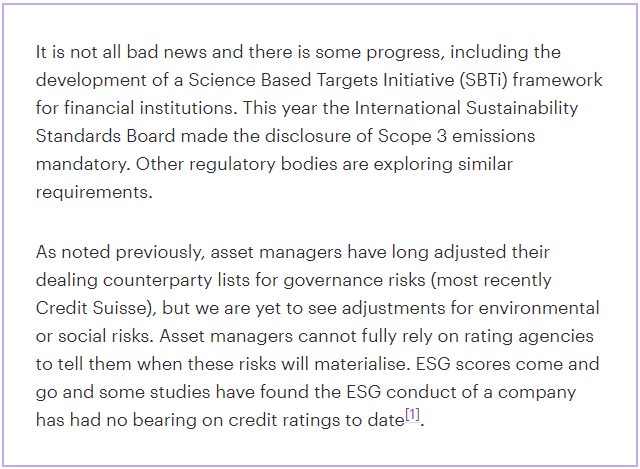
Asset managers need to properly evaluate the activities of those on approved counterparty lists, engage with them to get better disclosure and improved practices. They need to build their findings into their assessment of long-term counterparty risks.
What do we recommend asset managers do now?
As a base case, we expect asset managers to engage with regulators on BAU market issues (historical examples include RPI reform or the DB Scheme funding code) and on ESG. Managers should also engage with LDI and MMF counterparties (including clearing houses) on ESG issues through stewardship and investor relations teams. We also advocate for managers to participate in wider system engagement where managers believe it is beneficial and more impactful to do so. We have set asset managers “Sustainable Investing Minimum Expectations”, which include mandate level engagement reporting in recognition that asset owners care that the stewardship managers undertake on their behalf and are coming under increasing scrutiny in this area. Positively, managers are starting to do this.
As best practice, managers should broaden the scope of those carrying out engagement activity to maximise impact. This could be done through engaging via dealing desks plus heads of trading desks, and this can be applied to other strategies outside of LDI and MMFs. ESG issues are vast, complex and vary by counterparty. It is the responsibility of asset managers to recognise this and reflect it in their approach. We have been encouraging LDI managers to engage with their counterparties for several years, including through trading and portfolio management teams. This is now starting to gain traction and is one way we can identify leading asset managers. Managers have informed us that engaging through these teams is giving them greater access to senior decision makers and can lead to more productive conversations regarding ESG topics.
We expect asset managers to have an escalation policy and engage accordingly. In a few years’ time we expect the differentiation in leader and laggard counterparties will become more apparent and will prompt escalation in some cases.
We are not recommending managers start removing banks from counterparty lists now. We accept managers have complex fiduciary responsibilities, not least the need for best execution. As usual, there are several investment considerations at play here.
Asset managers may want to consider reducing exposures to laggards in MMF portfolios or shortening the tenors of contracts with laggard banks in time, providing this can be done without compromising the intent of the mandate. The same principles can be applied when considering counterparty risks through currency, deposit or repurchase agreements for example. Any changes made to counterparty lists need tobe carefully considered as part of determining the appropriate action when escalating an engagement.
What can asset owners do?
Challenging LDI and money market managers to demonstrate they are effectively integrating ESG and engaging remains key. Reviewing manager ESG and engagement reporting on the underlying issuers held in the portfolio and with clearing houses is a good start. Asset owners may want to probe managers regularly on what activity is taking place and who they are engaging with. Asset owners can then infer whether minimum standards are being met through the stewardship team or if the manager is striving for greater impact through, for example, engaging with dealing and portfolio management teams. Asset owners may want to consider developing an escalation policy for lagging managers.
In certain circumstances asset owners may have customised counterparty lists. We invite these asset owners to consider engaging directly with their client representatives at counterparty banks to express their views on ESG. Where there is flexibility to change counterparty lists, asset owners may want to develop an escalation policy for lagging counterparties.
Like all sustainability issues with asset managers and holdings, asset owners may want to embed reviewing their LDI and MMF manager approaches to ESG and engagement into regular sustainability reviews. Engagement in this area can then be communicated back to members and to the regulator as part of sustainability disclosures, moving asset owners themselves closer to best practice and being better positioned against risks moving forwards.
- IEEFA, 2023. Return to article