As part of launching the Global Asset Owner Technology and AI Peer Study, the Thinking Ahead Institute and MSCI Institute hosted a Summit which brought together asset owners, investment leaders, technology specialists and industry practitioners to explore how AI is reshaping investment organisations.
The governance and risk session of the event focused on a central theme from the study: AI is creating new opportunities, but it is also changing how organisations see and think about accountability, risk, decision-making and oversight.
The one message that was clear is that AI does not reduce the need for governance. It increases its importance and broadens its scope.
The investment industry has spent decades developing governance frameworks for investment decisions, risk oversight and accountability. However, many of these frameworks were designed for a world in which people made decisions supported by technology.
AI changes this relationship. Governance can no longer be viewed only as a board responsibility or compliance function. It must cover the interaction between people, processes, technology, data and AI systems.
The peer study findings suggest that governance maturity is not yet keeping pace with AI ambition. Organisations are becoming more active in testing and adopting AI, but their governance frameworks are often still developing. AI is rapidly becoming a strategic issue, while the structures needed to oversee it effectively remain a work in progress.
The polling of the event audience reinforced this challenge. When participants were asked whether their boards had sufficient AI capability to provide effective strategic oversight, the responses showed considerable uncertainty. Few organisations were fully confident that their boards were ready for the task.
A second poll asked which governance capability most needed improvement. Measurement was one of the leading responses.
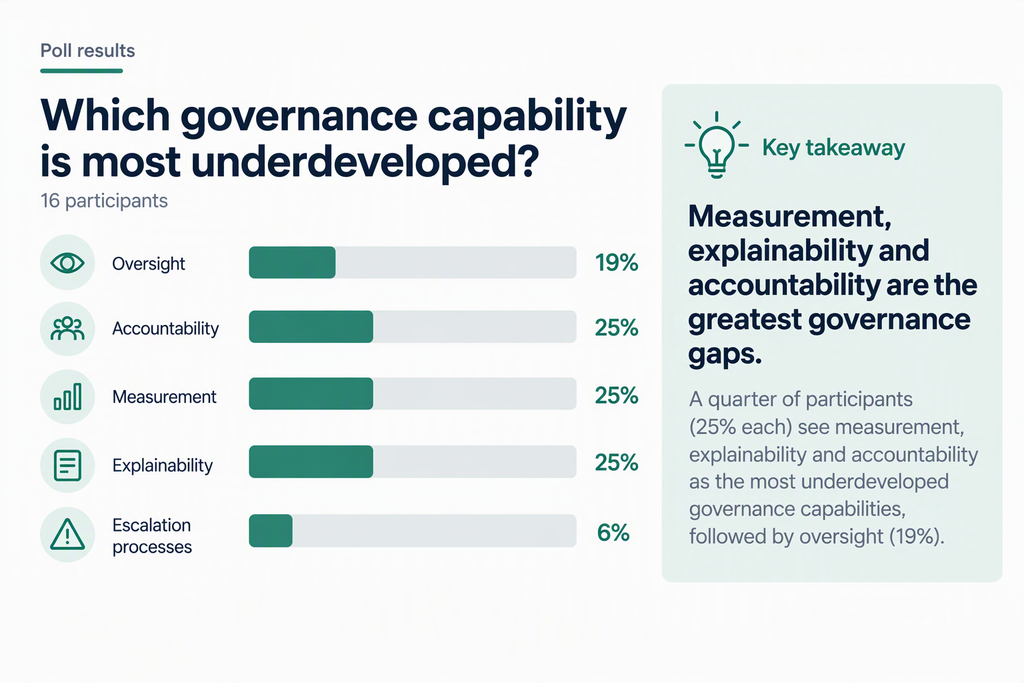
Investment organisations are not yet confident in assessing whether AI is improving judgement, strengthening decision quality or contributing to better long-term outcomes.
This creates an important governance challenge. Traditional frameworks often focus on financial performance and other outcomes that can be clearly measured. AI requires organisations to think more broadly about what success means and how it should be evaluated.
The study also points to a broader understanding of risk. Investment risk has traditionally focused on areas such as volatility, benchmark performance, tracking error and market exposure. AI introduces risks that do not always fit neatly into these existing frameworks. Resilience, preparedness, organisational survival and systemic risk are therefore becoming more relevant.
Peer study participants highlighted several immediate concerns. These included AI errors and hallucinations, where outputs appear convincing but contain incorrect information. They also raised the risk of over-reliance on AI, particularly if professionals accept its outputs without sufficient challenge or independent judgement.
Cybersecurity and data privacy also remain major concerns.
The growth of AI agents adds another layer of complexity. As organisations move from tools that assist people towards systems capable of completing tasks more independently, questions of supervision, accountability and control become more difficult.
Investment organisations could eventually use large numbers of AI agents to undertake research, analysis, reporting and operational tasks. Governance frameworks designed mainly for human workforces may therefore need to evolve.
Despite these changes, human accountability remains fundamental. Responsibility for decisions cannot simply be passed to technology. Organisations need clear human oversight, explanation and challenge throughout AI-enabled processes.
Governance itself must also become more adaptive. Traditional policies and controls often change slowly, while AI develops rapidly. Organisations will need to review their approaches to data, models, risk controls and decision rights regularly.
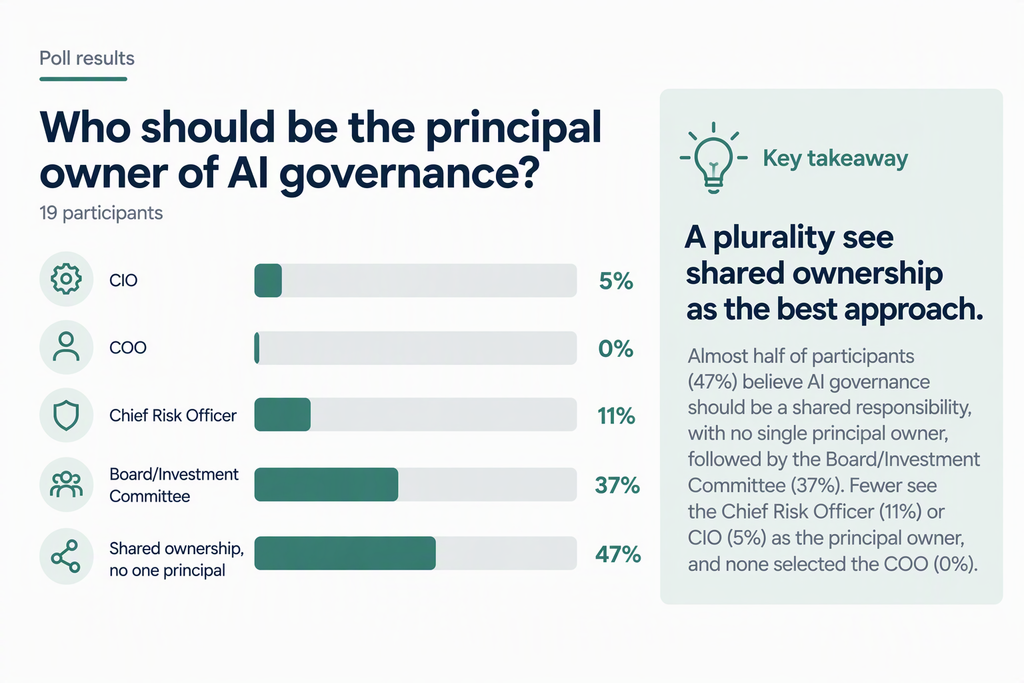
The final poll asked who should own AI governance. Shared ownership was the strongest response. AI crosses organisational boundaries, so responsibility cannot sit only with boards, technology teams or risk functions. Effective governance requires leadership, investment professionals, operations, technology and risk teams to work together and share accountability.
Overall, governance in an AI-enabled organisation is moving beyond traditional oversight towards a broader model of stewardship. The goal is not simply to monitor outcomes. It is to ensure that people, processes, data, technology and AI systems work together in support of the organisation’s objectives, while protecting trust, accountability and resilience.
The organisations that succeed will balance innovation with control, agility with accountability, and technological progress with human judgement. In the age of AI, governance is about helping organisations learn quickly and adapt responsibly.
This article is the second in a series exploring key themes from the study. You can read the first insight here.