Earlier this month, the Thinking Ahead Institute and MSCI brought together asset owners, investment leaders, technology specialists and industry partners to explore an important strategic question: how can investment organisations move from experimenting with AI to achieving meaningful organisational change with AI-enablement?
The technology and AI strategy session of the Global Asset Owner Technology and AI Peer Study Roundtable showed that the industry is increasingly confident about AI’s potential, but is still working through the realities of adoption.
The conversation has clearly moved forward. The question of whether AI matters is settled. Asset owners are now asking how to prioritise it, govern its use, measure its value and embed it across the investment organisation.
Polling of the roundtable participants provided a strong signal about organisations’ priorities. When participants were asked what advantage they most wanted AI to deliver, the leading responses were better decision-making, stronger learning and greater adaptability. Cost reduction ranked much lower.
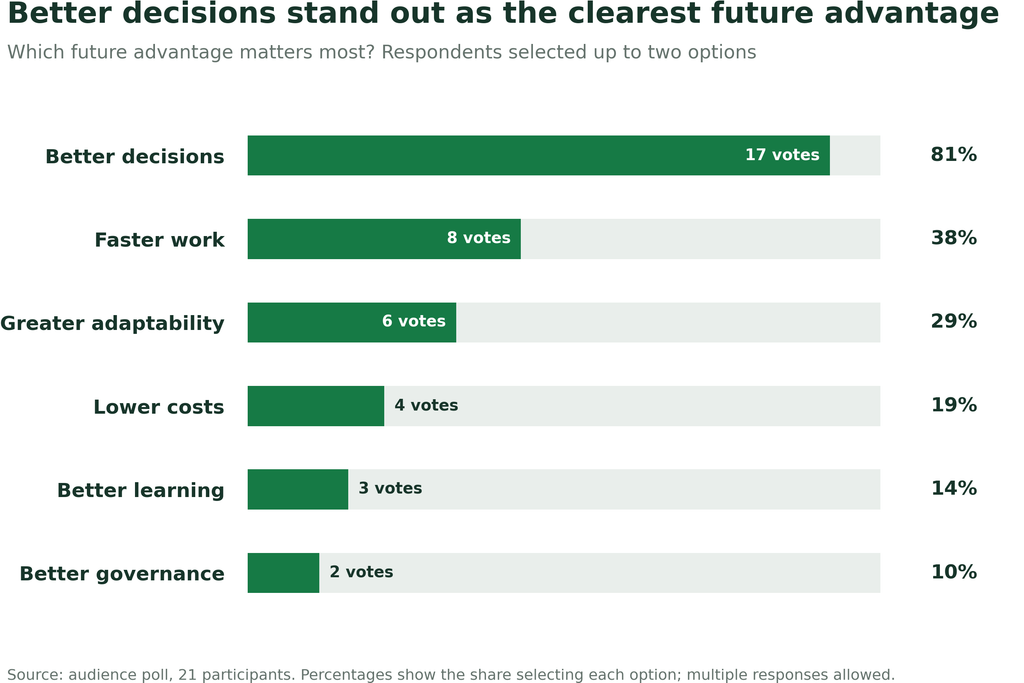
This has an important implication for the investment industry. Public discussion often presents AI mainly as a way to automate tasks and reduce costs. Asset owners appear to see a broader opportunity. They want to use AI to improve judgement, learn more quickly and make better decisions in uncertain conditions to achieve better long-term outcomes.
Participants also increasingly viewed AI as an organisational and strategic initiative, rather than simply a technology project. AI may once have sat mainly within technology departments or innovation teams. It now affects investment processes, governance, operating models, talent, culture and organisational design.
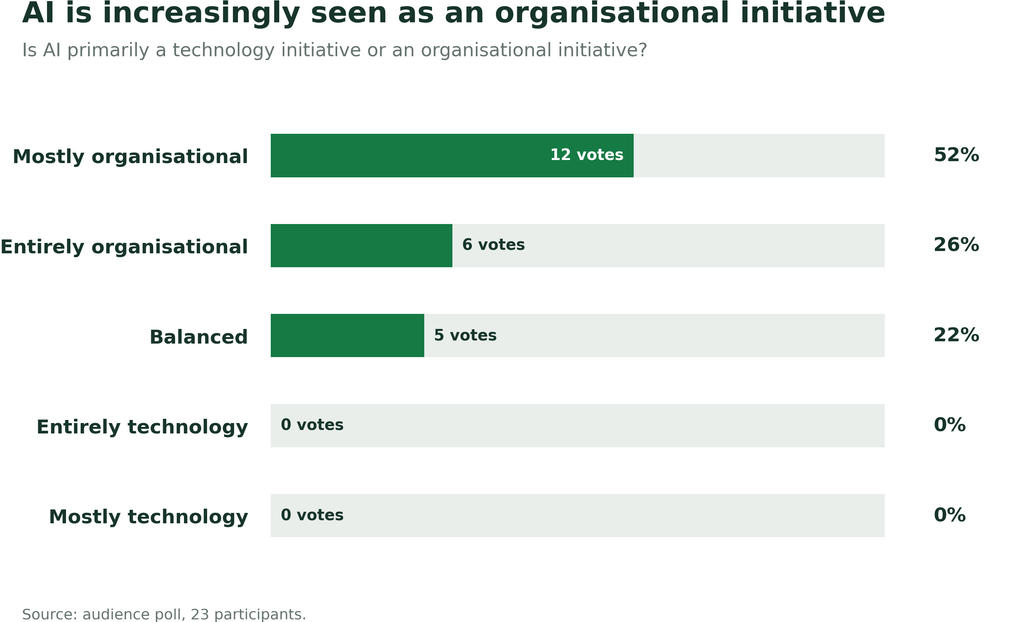
For leadership teams, this changes the nature of the challenge. Success depends less on selecting the right tool and more on aligning the organisation around clear goals and priorities. Access to technology is not necessarily the main barrier. The harder questions are where AI should be applied, how resources should be allocated and how its value should be assessed.
The peer study findings supported this view. AI and agentic tools emerged as the highest-ranking area of strategic focus, alongside the growing use of Total Portfolio Approach frameworks. Importantly, participants did not see these as isolated programmes. They increasingly viewed them as part of wider organisational transformation.
However, most asset owners are still at a relatively early stage. The study’s maturity framework ranges from initial experimentation to fully AI-native organisations. Most participating organisations currently sit between early deployment and integration. Interest and activity are high, but the industry remains some distance from widespread AI-native operating models.
Participants also questioned whether every organisation should aim to become fully AI-native. For some asset owners, the right destination may be an organisation in which skilled professionals are supported by AI, while people retain clear oversight and accountability. There may therefore be several successful end states, rather than one model for the whole industry.
Data remains one of the biggest barriers. The study identified data quality and standardisation as common challenges. Participants highlighted fragmented datasets, legacy systems and difficulties bringing together information across public and private markets. AI may be developing rapidly, but many organisations still need to improve the foundations on which it depends.
People and capabilities are just as important. Organisations further along the maturity curve stressed that advantage does not simply come from having access to AI tools. It comes from creating a culture in which people know how to use them effectively. Skills, continuous learning and adaptability are becoming strategic assets. This closely reflects the polling results, where learning and decision quality ranked ahead of traditional efficiency goals.
The discussion also highlighted a tension between leading and following. Several participants described their organisations as “fast followers”, aiming to benefit from innovation without taking on the risks faced by first movers. But this raises a wider question: if everyone wants to follow, who will lead? With technology, vendors and business models changing quickly, waiting may also carry risks.
The main takeaway is that the next phase of AI adoption in investment management will not be shaped by technology alone. It will depend on how well organisations connect strategy, governance, data, skills and culture around new ways of working.
The leaders may not be those with the most sophisticated tools. They are more likely to be the organisations that learn fastest, adapt most effectively and build the strongest connection between human and artificial intelligence.
For asset owners, the challenge is becoming clearer. The question is no longer whether to adopt AI, but how to turn AI ambition into organisational capability, better investment decisions and stronger outcomes for beneficiaries. That journey has begun, but there is still significant ground to cover.