Artificial intelligence (AI) has reached an important inflection point in investing. The question is no longer whether AI will be adopted, but how investment organisations redesign their operating models, workflows and decision processes around the combination of human and artificial intelligence.
This theme has been explored through the Thinking Ahead Institute’s Technology Ecosystem Working Group, which brought together asset owners, asset managers and industry experts to examine the changing role of technology and AI in investing.
This article builds on the first insight in the series, “A systems view: understanding AI through 12 lenses”, which argued that AI should be viewed through multiple lenses rather than as a purely technological development and one that is reshaping most of the systems that we depend upon – social, environmental, economic, political, legal and ethical.
Beyond tools: building AI into the organisation
Discussions about AI often appear fragmented because people are focusing on different aspects of the same challenge. Some see the opportunities for greater efficiency, insight and innovation, while others focus on the risks around governance, trust and accountability. Both perspectives matter because AI is shaped by all of these considerations.
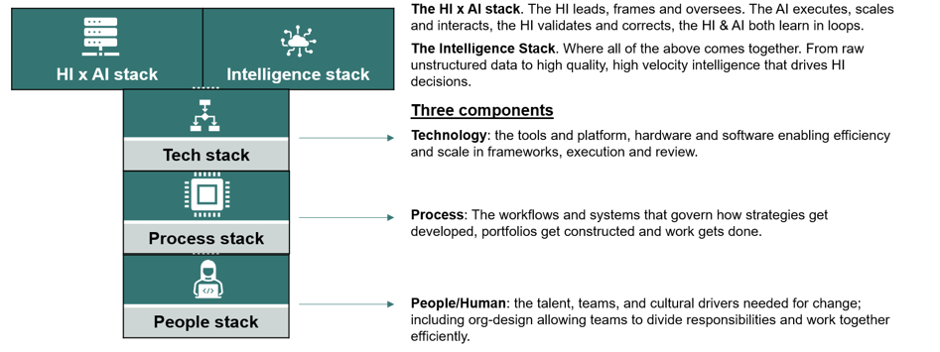
An effective AI strategy therefore needs to consider how AI fits into workflows, decision-making processes, skills development, data infrastructure, culture and governance. Increasingly, this points towards a new operating model built around connected people, process and technology capabilities, with human and artificial intelligence working together through an integrated intelligence system.
At present, AI adoption remains uneven, with innovation emerging in isolated pockets while a clear organisation-wide strategy remains limited. Ultimately, successful adoption depends as much on organisational design and ways of working as it does on the technology itself.
Figure 1 illustrates a 2.0 operating model in which people, process and technology are integrated into a single intelligence system rather than operating as separate organisational domains.
‘2.0’ denotes the upgrade of the 1.0 operating model for human intelligence alone
The HI × XAI proposition
As investment organisations consider how AI should be used, the central proposition is the HI × XAI combination: human intelligence working alongside explainable artificial intelligence. The opportunity lies in designing an effective partnership between the two, where the outcome is more than the sum of its parts.
Human intelligence brings purpose, judgement, context and accountability. AI brings speed, scale and analytical power. The objective is not to replace human judgement but to reallocate work to the intelligence best suited to the task. Together, they can produce better insights and support better decisions.
Explainability is what makes this partnership investable and governable. When people can understand how AI reaches its conclusions, they are better able to challenge, refine and trust its outputs. AI becomes less of a black box and more of a decision-support partner, improving both the quality and speed of decision-making.
This partnership matters because investment value is created through an intelligence chain that moves from data and analysis to judgement, decision-making and action. The strongest organisations will be those that deliberately combine human and artificial intelligence across this entire process, creating a more effective intelligence stack.
Building the investment intelligence stack
As data becomes abundant and analytical tools become widely available, future edge in investing will increasingly depend on how effectively organisations combine information, judgement, experience and learning. The challenge is no longer only finding answers, but knowing which questions matter and how to turn insight into action. The concept of the intelligence stack describes how investment organisations transform information into better decisions.
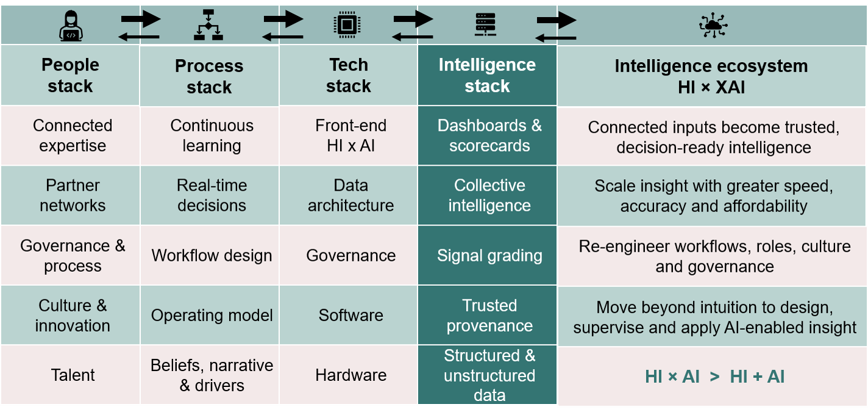
The intelligence stack can be thought of as the set of layers through which information becomes decision-useful. Data provides the foundation. Analysis turns data into insight. Human judgement adds context, interpretation and accountability. Governance and decision-making then translate insight into actions that can improve portfolio outcomes.
AI can strengthen every layer of the intelligence system. But perhaps its most distinctive contribution is the hyperscaling of intelligence. By dramatically increasing the ability to access, retrieve, parse, organise and synthesise information, AI expands the organisation’s cognitive reach across both structured and unstructured data.
This shifts the source of advantage. Competitive edge comes less from possessing information and more from converting information into decision-useful intelligence. The leading organisations will use AI to increase the breadth, depth, velocity and accessibility of intelligence throughout the investment process.
As data becomes abundant and analytical tools become widely available, future edge in investing will increasingly depend on how effectively organisations combine information, judgement, experience and learning. The challenge is no longer finding answers but knowing which questions matter and how to turn insights into action. The concept of an intelligence stack explores how investment organisations transform information into better decisions.
Figure 2 illustrates the intelligence stack: the cognitive production system through which data becomes information, information becomes insight, and insight becomes judgement and action.
Better intelligence comes from connecting people, process and technology.
Embedding AI into the operating model
The intelligence stack creates value when it is embedded into the organisation’s day-to-day operating model and end-to-end processes.
At present, many organisations still treat AI as an add-on to existing processes. This can improve productivity, but the larger opportunity is to redesign how work gets done: where AI supports analysis, where humans apply judgement, how decisions are challenged, and how accountability is maintained.
In an industry where information is increasingly abundant, advantage will come from the ability to combine data, technology, human judgement and organisational learning into better decisions over time in the hyperscaling of intelligence.
It increases the breadth, depth, velocity and accessibility of intelligence. The competitive edge shifts from possession of data to mastery of the intelligence stack to convert data into judgement and judgement into action.
The prize is not AI adoption for its own sake. It is a better intelligence system: faster where speed matters, more explainable where trust matters, more joined-up in its relationships and more human where judgement matters most.
The winners are unlikely to be those that adopt AI fastest, but those that build the strongest intelligence systems around it. The long-term prize is not automation, but the proposition that combining human judgement and explainable AI creates a superior intelligence and decision system and a more scalable, adaptive and effective investment organisation.