Artificial intelligence (AI) is at a turning point in the investment industry. What started as small-scale experiments to improve colleague productivity is quickly becoming part of everyday investment activity, influencing research, operations, client servicing and, increasingly, investment decision-making itself.
Over the last 6 months, the Thinking Ahead Institute’s Technology Ecosystem Working Group brought together asset owners, asset managers and industry experts to explore what AI means for the future of investing. The discussions revealed a consistent theme, that AI is not simply a technology story. It is simultaneously a people story, a governance story, an organisational story and a systems story. Looking through only one perspective risks missing the bigger picture.
This becomes harder given that AI has no single agreed definition. The term is used to describe rule-based systems, statistical models, neural networks and generative tools. The common thread – they are all technologies that share little in common beyond the ability to perform tasks that once required human judgement.
Today, AI typically refers to systems that process inputs, identify patterns or relationships, and produce outputs without being explicitly programmed for each outcome. It can be broadly classified across three dimensions: what it does, how it works and how independently it acts.
For this reason, we developed the 12 AI lenses to help investment organisations take a broader view of this hyper-broad subject. These lenses provide a practical framework to move beyond the immediate excitement surrounding AI and think more deeply about what it may mean for investment outcomes, organisational effectiveness and system resilience over the years ahead.
Seeing AI through multiple lenses
AI is often discussed as if it is one thing: a tool, a model, a productivity booster, or a threat. It is, however, a multi-faceted, systemically important socio-technical phenomenon, and no single lens is enough to understand it.
The value of the 12 lenses is that they help investment organisations avoid a narrow conversation. It frames AI through a set of lenses covering the viewpoints of individuals (including public opinion), macro factors, organisational design factors and wider collateral effects (AI doesn’t affect one thing, it affects everything).
Increasingly, AI affects how judgement is formed, how information is processed, how organisations learn, how governance evolves, and how scarce resources such as energy are used. For investors, this means AI adoption requires a joined-up approach across people, process, technology, governance and system-level thinking.
The twelve lenses we suggest below are framed from the viewpoint of the investment industry but anchored in the wider societal ecosystem. Taking too narrow a view will miss important factors, taking too broad a view risks being overwhelmed.
The 12 lenses: a reference guide
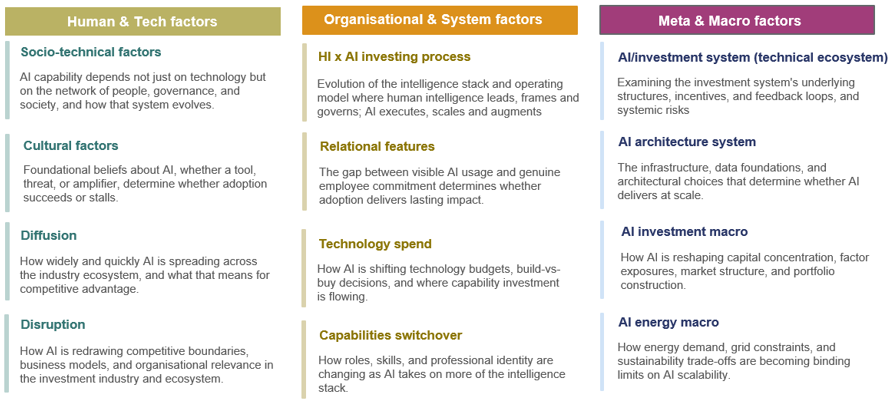
The 12 lenses – what are we looking at?
1. AI as a socio-technical system
AI should be viewed as part of a wider ecosystem change across society involving people, culture, government, incentives on top of the technology itself. Successful AI adoption requires changes to personal lifestyle, to ways of working and to everything it means to be ‘human’. In short, all features of a massive resetting of societal values and behaviours.
2. Cultural factors relating to AI
Technology alone does not determine success. What is critical is how the workforce and society broadly respond to technology’s influence. This will reflect how safe colleagues feel in its presence, will it take away jobs or enhance them. Building confidence in AI is a leadership challenge to bring shared understanding of AI’s benefits and its limits.
3. Diffusion of AI technology
Diffusion assesses the adoption of AI across society and across organisations. In the investment industry, AI is diffusing rapidly as a tool for research, operations and reporting, but less so in investment-making. AI strategy is in its infancy and AI diffusion will reflect a mixture of strategic ambition, technology adoption and operational effectiveness.
4. Disruption from AI
Organisational disruption is an inevitable outcome from this massive scale impact from this general-purpose technology. Disruption manifests in differential outcomes – winners and losers reflecting different AI strategies and incumbencies. There are big challenges from legacy thinking and legacy systems, hence the big part played by frontier firms.
5. HI × AI
The most effective investment model combines human judgement with AI capabilities. AI can analyse information at scale and improve efficiency, while people remain responsible for context, challenge, oversight and accountability. This means designing the architecture and orchestration of HI and AI interaction to benefit from combinatorial effects.
6. The relational ecosystem
Successful AI adoption in investment organisations depends on how people experience change in their relationship with the technology. High levels of AI use do not necessarily mean genuine adoption if employees lack confidence or don’t experiment. Leadership plays a critical role in creating the environment where people learn and adapt.
7. Technology spend
Investment organisations are increasing their technology spend across systems, data and now with AI tools. As a rough guide technology spending has grown to be between 10% and 20% of total ongoing expenditure at investment organisations. Increasing spending on AI is anticipated but strategies will vary in their emphases and outside vendor reliance.
8. Capability shift
As AI takes on more routine analytical tasks, the focus of investment professionals will increasingly emphasise time spent on governance and process design; and judgement, interpretation, and oversight. These are the areas where the AI lacks context and accountability, leaving human input to provide these higher value-adding tasks.
9. The technical ecosystem
The adoption of AI affects the investment ecosystem. The investment markets have evolved to their present shape with bumps in the pathway but retaining overall integrity in pricing and execution. Markets rely on diversity and if organisations adopt similar AI tools and models, markets could become more concentrated and fragile.
10. The system architecture
Choices about AI platforms, models and infrastructure will influence future governance, workflows and competitive advantage. Investment organisations almost all choose hybrid technology ‘stacks’ with heavy reliance on outside system and internal operation. AI is a vendor driven market. Technology decisions are increasingly strategic business decisions.
11. AI as a macro investment force
AI is rapidly reshaping industries, competitive advantage and capital flows. The rise of the hyperscalers – notably Microsoft, Amazon and Alphabet – is one manifestation of this. It creates investment opportunities (notably data centres) but is also increasing concentration in large technology firms and introducing new resilience challenges.
12. The energy nexus
AI relies on significant computing power, data centres and electricity. Energy availability, infrastructure and sustainability considerations will increasingly shape how quickly AI can develop, making it both a technology and an infrastructure investment theme. The energy pipeline and bottlenecks will increasingly be factors in AI diffusion.
It is evident, that AI in investing is not just a technology adoption challenge. Its implications run much deeper, influencing the system design and reshaping the investment process, operating model, talent model, governance model and the broader system in which investors operate. And society’s increasingly jaundiced view of its net benefits is something to watch out for.
The working group’s key insight is that AI adoption is still early and uneven, but the direction of travel is clear: investment organisations are moving towards hybrid intelligence, where human judgement and artificial intelligence work together through better data and better processes. But achieving this will involve a massive ask of organisational flexibility through stronger guardrails, effective governance and faster learning loops.
For asset owners and asset managers, the opportunity is significant. AI can improve speed, scale and accuracy. It can make data more usable, strengthen knowledge management and support more joined-up decision-making. But the risks are equally real: weak governance, poor culture, platform dependence and rising costs. The organisations that make most progress will not be those that treat AI as a plug-in tool. They will be those that build the human, organisational and system capabilities needed to use AI well.
In that sense, the 12 lenses are not just a framework for understanding AI. It can be a practical checklist for better investment leadership in the AI era. And it certainly should influence how discourse is undertaken.
A primer for tackling AI discussion
Thinking
1. AI is AI is not one story but a collision of technical, organizational, and social stories that defies a single coherent narrative.
2. Expect dissonance and disagreement. If the system is genuinely socio-technical, different people will be seeing different but valid parts of it.
3. Aim for shared understanding, but do not expect one master story. The point of the dialogue is to surface the different layers and connect them. Understand AI-as-a-system.
Action
1. Structure the conversation by lens. Use explicit lenses to stop people talking past each other. Noise comes from mixing levels of analysis without naming them.
2. Layer clearly; Human — judgment, behavior, trust, regulation, values; Organizational — workflow, incentives, authority, operating model; Technical – models, data, infrastructure.
3. Anchor dialogue in purpose “what problem are we trying to solve?” What decision, risk, opportunity, or change are we actually here to address?” Keep practical.