This note is a bit more than about books. It’s a flow: books > text consumption in all forms > thinking > cognitive excellence > intelligence > 100,000 decisions on a good day > a different world.
You give the time and the thinking, and you get the dopamine hit from learning and the growth from being a tad smarter. Your neuroplasticity fires up. You strengthen your neural pathways, reasoning and empathy, sharpening your critical thinking and systems thinking, increasing your sense-making and focus, and making better judgements.
It is a scientific fact that reading accelerates the growth of your mind. You engage memory through the hippocampus that stores what you’ve read. And here’s the best bit: when you encounter new information, your brain matches it to your existing ‘schema’ – the mental models and organising frameworks where new stuff is sorted and it’s added to your intelligence. This is the place where you keep a working model of the outer world and the intricate sense of your inner self.
And fiction earns its place as well as non-fiction. Good fiction is a simulator for extending the mind: it trains perspective-taking, empathy and the ability to read people in context. Non-fiction tends to sharpen models, facts and frames; fiction tends to sharpen social imagination. The best reading life probably needs both: the hard stuff that improves our maps of the world, and the soft stuff that improves our feel for the people in it. Note to self. 😊
A big theme is better meta cognition – thinking about thinking, becoming crucial in the human intelligence HI à HI x AI transition.
So my six-word specs for future-fit reading are these: systems-navigating, score-keeping, sense-making, people-reading, bridge-building and tech-connecting. They are not a syllabus; they are prompts. They help me choose books that do more than inform. They help build the muscles we need for work and life: seeing systems, reading signals, making judgement, understanding people, connecting across boundaries and staying intelligently joined-up with technology.
This matters more in a post-AI world, not less. AI will give us more answers, summaries and pattern-recognition at speed. But it will not remove the need for judgement; it raises the premium on it. The human edge moves towards asking better questions, knowing what to trust, sensing what is missing, understanding context, and combining human intelligence with machine intelligence without surrendering responsibility.
That is why curation and score-keeping comes first and sense-making comes second. Curation is the selection problem: what deserves attention when attention is scarce? Score-keeping is a lot connected to listology, what are the top or bottom in priorities, issues, and risks, now and going forward? Sense-making is the integration problem: what does it mean, what connects, what changes my model, and what should I do differently? The best reading combines both. Curation focuses and upgrades the internal operating system that turns inputs into the sense-making insight.
My list below is organised less by the genre and more by the cognitive. Some books help us see the architecture beneath complexity. Some help us notice when the score has replaced the value. Some improve forecasting, language and judgement.
My reading is definitely getting some AI pushing
AI can amplify intelligence, but it can also amplify confusion, bias, speed, mimicry and misplaced confidence.
The human task is orchestrating the combination: set purpose, design workflow, check evidence, preserve accountability.
This reading list is a preparation for the next cognitive regime: better readers > better thinkers > better orchestrators.
First, more abundant intelligence: answers, drafts, analysis and synthesis will become cheaper and faster. Hallelujah.
Second, more pressure on judgement: when everyone can generate plausible content, the scarce skill becomes knowing what is true, useful, original and responsible.
Third, more importance for metacognition: thinking about thinking, prompting, checking, challenging, framing and deciding.
Fourth, more blurred boundaries between learning and working: the best users will learn with AI as they work with AI.
Fifth, a premium on human qualities that machines
do not possess: trust, wisdom, courage, care, humour, humility and the ability to hold ambiguity without rushing to closure. Humans have never been more needed to apply their best agency to the system.
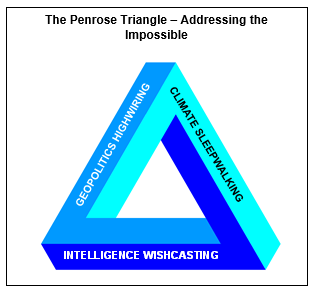
And sixth, I hope, a hopeful answer to the three rod Penrose triangle — the mind insists on coherence but the geometry refuses it. The answers to our twin perils in geopolitical highwiring and climate sleepwalking I think can lie in intelligence wishcasting. If we super intelligently get it right we get our wish. But wishing needs a strategy that is much bigger than relying too much on hope.
Hope is not a strategy.
July 2026 reading suggestions
The books I have curated in this list come from four of these 6-word specs: systems-navigating, score-keeping, sense-making, and chilling. That prompt helped me choose them, I hope it helps you find something that is the win-win of the hyper-valuable and hyper-enjoyable. Overleaf I’ve done a precis of five of them, trust me it’s way too long if you have the full set.
By the way, each year I get more help in compiling this list, that’s the way curation should work. 😊 With thanks for those who’ve helped me.👏 Notably Gail, the kids, and the grandkids, and Philip who has been such an inspiration. A Kiwi who loved ‘The Year of Living Danishly’ – one of my best ROATs (reads of all time).
| Summer 2026 reading | ||
| Systems-navigating | Scale by Geoffrey West | Size changes everything |
| Thinking in Systems by Donella Meadows | Structure drives behaviour | |
| System-Level Investing edited by Jon Lukomnik | Portfolios need systems thinking | |
| Complexity: A Guided Tour by Melanie Mitchell | Emergence from interaction | |
| Score-keeping | The Score by C. Thi Nguyen | When metrics mislead |
| Lessons from Game Theory by Michael Wooldridge | Incentives shape outcomes | |
| The Year of Living Danishly by Helen Russell | Wellbeing by design | |
| The Emergent Mind: by Gaurav Suri and Jay McClelland | Intelligence from connections | |
| Sense-making | The Precipice by Toby Orr | Risk at species scale |
| The Happiness Files by Arthur C. Brook | Life as architecture | |
| Superforecasting by Philip Tetlock & Dan Gardner | Judgement under uncertainty | |
| The 21st Century Brain by Hannah Critchlow | Future-proof the mind | |
| Chilling-out | Bridge Beyond the Stars by Cornelia Funk | Imagination as oxygen |
| Stuck by Olivia Jeffers | Silliness resets intelligence | |
| Tomorrow and Tomorrow and Tomorrow by Gabrielle Zevin | Creativity as collaboration | |
| 500 words you should know by Caroline Taggart | Language sharpens observation | |
Systems-navigating
Scale by Geoffrey West
This got my vote in 2018 and it has aged well. I’ve brought it back because it is so important. West makes scale feel like a hidden grammar of life: organisms, cities and companies look messy on the surface but often obey surprisingly regular mathematical laws. It was the book that got me properly understanding the exponential function and the S-curve: why growth can feel slow, then sudden, then constrained. The strongest idea is that size changes everything, but not in a straight-line way. Cities become more efficient in some ways and more intense in others; companies scale differently again; biological systems eventually hit limits. This is why the book belongs under systems-navigating: it teaches you to look for the architecture beneath the activity. My take-away: when systems grow, they don’t just get bigger, they change character. Scale creates leverage, but also fragility. The art is knowing whether you are still on the exponential, approaching the S-curve, or already living with the limits.
Score-keeping
The Score by C. Thi Nguyen
Nguyen’s key point is that games work by giving us temporary, simplified goals and clear scores. That is powerful and often beautiful in games, because we knowingly step into an artificial value system. But the danger comes when game-like scoring systems escape into real life: the score starts to replace the value. Nguyen’s warning is that scores are seductive because they compress complex value into tractable objectives. In games this is art; in organisations it can become pathology. The score captures attention, gamification follows, weak signals are laundered into apparent objectivity, and the original point is missed. Nguyen helps explain the trap: once a score captures value, people play the score. That produces gamification, signal laundering and, ultimately, point-missing. My prediction – AI will lead to a big up-tick in soft data influence, but with side effects from data laundering.
Sense-making
The 21st Century Brain by Hannah Critchlow
Critchlow is exactly the right neuroscientist for this list because she treats the brain as both ancient hardware and adaptive software. The book’s core optimism is neuroplasticity: the brain can keep learning, rewiring and strengthening the skills that matter most in an AI-saturated world. That does not mean competing with machines on machine terms. It means becoming more fully human: better at emotional intelligence, collaboration, imagination, flexible thinking, long-term judgement, resilience, intuition and connection. This links back to the opening theme of reading as mind-growth. The 21st-century brain is under pressure from distraction, overload, uncertainty and technology, but it is also built to adapt if we give it the right inputs: sleep, nutrition, attention, social connection, learning and reflection. My take-away: future-proofing the mind is not a productivity hack; it is a human-intelligence strategy. In the age of AI, the smartest move may be to strengthen the brain’s most human capacities.
Chilling out stuff
Bridge Beyond the Stars by Cornelia Funke
The age guide is 9+. That tells you that it is a bridge between ages. Funke gives you fantasy as imaginative oxygen: a world beyond the ordinary, but still rooted in courage, friendship and wonder. It is soft chill-out stuff in the best sense — not lightweight, but restorative, story-rich and mood-shifting. The value is not in “lessons” so much as in reacquainting the mind with enchantment. My take-away: sometimes the best reading is a bridge out of the literal and back into possibility.
Tomorrow and Tomorrow and Tomorrow by Gabrielle Zevin
Zevin writes about friendship, creativity and collaboration through the unlikely but perfect frame of game-making. The book is really about how people build worlds together, and also wound each other while doing it. It captures the messy beauty of shared projects: talent, ego, love, timing, loss and reinvention. My take-away: the best creative partnerships are not clean stories; they are long games built to last through the path dependence that life is so full of.
Roger Urwin | July 2026