Insights from the Thinking Ahead Institute Global Asset Manager Peer Study 2026
Asset management is entering a re‑set moment. The industry has navigated cycles of innovation before, but the convergence of systemic risks, AI, and the evolution of private markets is creating something different in how firms must operate.
The Thinking Ahead Institute Global Asset Manager Peer Study (AMPS), based on insights from 176 managers representing approximately $39 trillion in assets, offers a rare, system‑level view of how managers are responding – and what is still work in progress.
The headline conclusion is clear: competitive advantage is shifting from investment alpha to organisational alpha (Org‑Alpha) – the edge created by how effectively firms integrate people, process and technology.
A system under pressure
AMPS starts from a simple observation: the asset management system is no longer stable, predictable, or decomposable. Instead, it is increasingly complex, interconnected and adaptive, shaped by multiple forces acting simultaneously.
These forces include:
- The rapid advance of AI and data‑driven decision-making
- The rise and integration of private markets
- A more fragmented geopolitical environment
The growing importance of resilience, stewardship and legitimacy
Importantly, these dynamics are not occurring in isolation – they are happening all at once, increasing the difficulty of navigating them through traditional, siloed approaches. This is why the study takes a systems thinking perspective, arguing that firms must move beyond local optimisation towards “joined‑up” operating models that can handle complexity.
Strong direction, weak execution
One of the most striking findings is the gap between directional clarity and operational readiness.
Across the AMPS sample:
- 70% of managers report a purpose that connects client returns, with broader societal and stakeholder orientation
- There is high conviction that HI x XAI (human intelligence combined with eXplainable AI) will be a decisive differentiator
- Foresight on key macro themes – AI, geopolitics, scale – appears strong and widely shared.
Yet this strength in intent is not matched by capability. Managers remain what the study describes as “pre‑stack”: strong in judgement, culture and critical thinking, but lacking the scalable systems to operationalise those strengths at speed and consistency. This imbalance – strong people, weak systems – creates a growing execution risk as complexity rises.
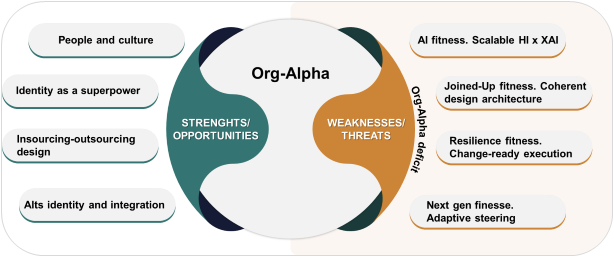
The Org‑Alpha deficit
At the heart of AMPS is the identification of four critical organisational deficits. These define the gap between where firms are today and what the future demands.
- AI Fitness
Firms are still early in building scalable, decision‑ready AI capability. Data remains fragmented, intelligence is weakly codified, and AI is often peripheral rather than embedded in core workflows. The challenge is not adding tools, but redesigning decision systems around HI x AI integration.
- Resilience Fitness
Despite high awareness that future outcomes will be shaped by non‑linearity and regime shifts, organisations remain oriented towards prediction and efficiency.
Resilience – defined as the ability to anticipate, absorb and adapt – is not yet embedded as a core organisational capability.
- Joined‑Up Fitness
Capabilities across teams, technologies and asset classes remain fragmented. Firms struggle to operate as coherent systems, particularly as portfolios become more complex and cross‑asset interactions intensify. This is a design problem.
- Next‑Generation Finesse
Finally, firms lack the adaptive “finesse” required to steer in complex environments. This includes balancing trade‑offs between efficiency and resilience, short‑ and long‑term goals, and private versus public markets. Taken together, these deficits explain why the industry, while directionally aligned, remains structurally under‑equipped.
Investment in technology: the missing link
The data reveals a clear signal: investment in technology is still lagging.
- Technology accounts for just 12% of operating expenditure
- By contrast, 38% of spend is allocated to frontline investment talent.
This imbalance reinforces the “pre‑stack” dynamic – talent is not being fully leveraged by scalable systems. The implication is that firms are still investing more in individual capability than in the infrastructure needed to scale it.
A new operating model: HI x XAI
The AMPS findings point toward a new cultural and operating paradigm: HI x XAI. This is not a story of automation replacing human judgement. Instead, it is about designing systems where:
- AI scales cognition across data and decisions
- Human intelligence provides intent, governance and accountability
In this model, the central question shifts from “How do we add AI?” to “Where should judgement be concentrated, and where should it be scaled?”
Firms that answer this effectively will be better positioned to create sustainable Org‑Alpha.
From alpha to Org‑Alpha
Ultimately, the AMPS reinforces a powerful shift. The future winners in asset management will not be defined primarily by better investment ideas, but by better organisational systems – firms that can combine:
- Strong human judgement
- Scalable technology platforms
- Joined‑up operating models
- Adaptive, resilient decision‑making
This is the essence of Org‑Alpha.
For those wanting to explore the concept further, the Thinking Ahead Institute’s Org‑Alpha research hub provides a deeper set of frameworks and diagnostics.
This is a HI x AI generated article using Thinking Ahead’s own research and data.