For much of the past half‑century, the investment profession has evolved through incremental improvement. New asset classes were added, risk models refined and technology steadily embedded into processes. Yet the underlying professional model — how judgement is formed, how decisions are made, and how responsibility is held — has remained remarkably stable.
But things are changing.
Our investment Professional 2.0 work starts from the recognition that the world investors operate in has changed faster than the profession itself. Markets are more interconnected and reflexive. Risks are increasingly systemic rather than idiosyncratic. Technology, especially AI, is no longer just a tool but an active participant in decision‑making. In this environment, the definition of professional effectiveness is broadening. Technical excellence remains essential, but judgement, adaptability and systemic thinking are becoming equally decisive.
Re-thinking talent for the AI era
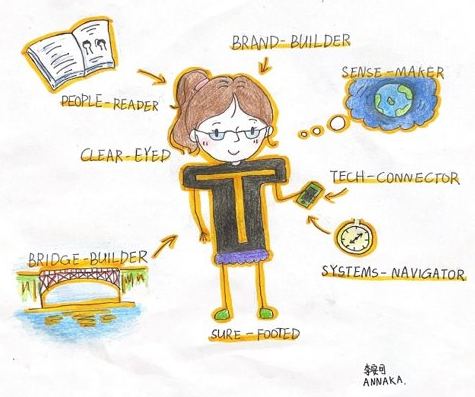
The investment professional of the future is neither a narrow specialist nor a pure generalist. Instead, they are T‑shaped: combining deep expertise in a core domain with strong horizontal capabilities. These horizontal capabilities include:
| Bridge- builder | Building strong and influential personal and corporate ‘glue’ relationships in which mutual trust is central |
| Systems-navigator | Building situational fluency in all of the multiple ecosystems you inhabit – your organisations, etc |
| Tech-connector | Ability to enable magic things to happen with technology driven by the HI (Human Intelligence) x AI combination |
| Sense- maker | Making sense of the world at the zoomed-out and zoomed-in levels driven by critical and systems thinking |
| Brand- builder | Developing personal brand growth and living the corporate brand driven by strong identity and authenticity |
| People- reader | Fluency with EQ and soft skills driven by growth mindset, inquisitiveness and empathy |
The traditional investment professional has been rewarded for optimisation: refining forecasts, improving models, and maximising performance within defined silos. These skills are still necessary, but they are no longer sufficient on their own.
The Professional 2.0 reflects a shift from optimisation towards sense‑making: the ability to interpret signals across the system, understand interactions and feedback loops, and exercise judgement when historical relationships break down.
This involves:
- zooming out as well as zooming in
- connecting information across disciplines
- recognising when familiar metrics no longer capture what matters
In short, the professional edge is moving away from pattern-matching and towards judgement in conditions where historical rules no longer hold.
The 2.0 Tech Professional: Stepping up
The tech professional of the future needs to be Pi-shaped, to be able to bridge multiple domains such as investment, technology and organisational design.
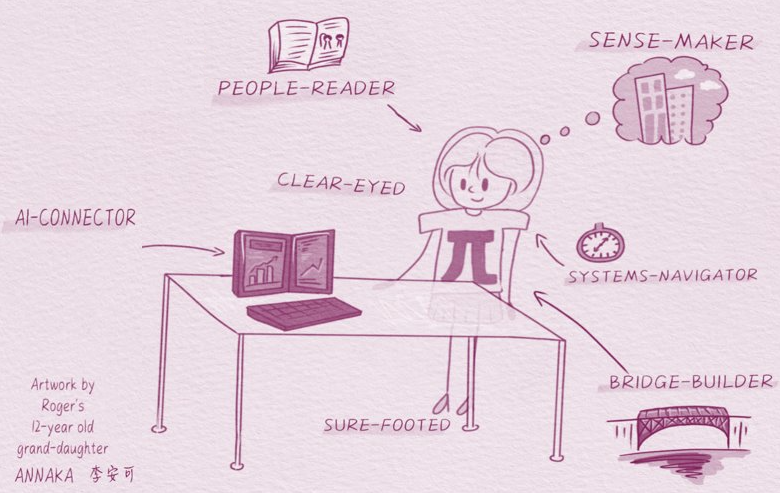
| From Tech specialist | – Smart data scientist & tech geek – Following linear thinking |
| To Sense-maker | – Zooming-out & zooming-in – Systems-casting the organisation |
| Tech-connector | – Pi-shaped tech connections – HI x AI combination architect & manager |
| Systems-navigator | – Situational fluency – Mental model-rich |
| Pi-shaped professional | – Strong horizontal in making connections – Strong vertical in domain knowledge |
Human judgement matters more, not less
A central insight of the investment Professional 2.0 is that advances in technology increase, rather than reduce, the importance of human judgement.
AI is powerful at pattern recognition, speed and local optimisation. It is far weaker at recognising regime change, questioning assumptions, or making value‑based trade‑offs. As systems become faster and more automated, the responsibility of humans becomes heavier, not lighter.
AI does not replace human intelligence — it amplifies it. Human Intelligence (HI) leads; Artificial Intelligence (AI) scales, a simple equation we like to use for this is: HI x AI. Humans lead, frame and judge while AI executes, scales and accelerates, and together they form a new intelligence model.
The Professional 2.0 therefore places renewed emphasis on:
- meta‑reasoning (thinking about how we think)
- ethical responsibility
- accountability for outcomes, not just process
- the courage to look wrong early
How does this fit in with risk, governance and total portfolio thinking?
Professional 2.0 is deeply intertwined with Total Portfolio Approach (TPA).
TPA asks investors to manage capital at the level of the whole system rather than through asset‑class silos. While often discussed as a technical shift, its success depends fundamentally on professional capability. It requires investors who can weigh opportunity costs, understand interactions across the portfolio, and make decisions under deep uncertainty.
Seen this way, TPA is not constrained by modelling sophistication but by professional readiness. Without that professional capability, even the most sophisticated TPA framework defaults back to siloed thinking in practice. The Professional 2.0 provides the human foundations that allow TPA, and broader systems‑level investing, to function in practice.
We position the Professional 2.0 alongside Risk 2.0 and Governance 2.0 as part of a wider 2.0 reset. Together, they respond to structural forces reshaping investment organisations:
- faster market clock‑speed
- tighter coupling between actors and systems
- greater systemic fragility
- rising expectations of stewardship and accountability
The investment Professional 2.0 is about creating the conditions for better judgement at scale, recognising that in a complex, fast‑moving world, professional capability is becoming as important as capital itself.
This is a HI x AI generated article using Thinking Ahead’s own research and data.